
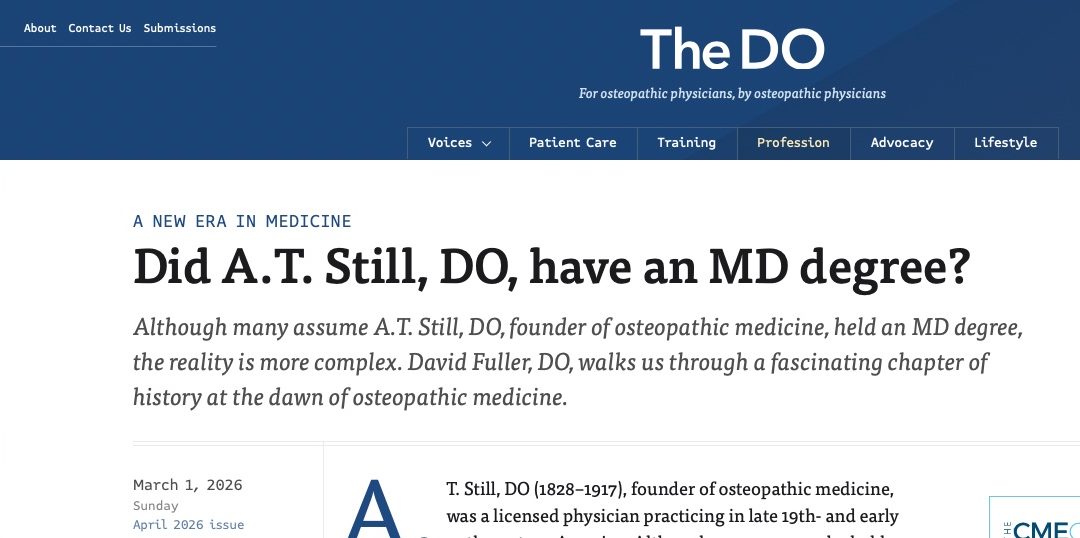
Source: https://osteopathic.org/2026/04/16/did-a-t-still-do-have-an-md-degree/ (accessed May 6, 2026).
The recent commentary and historical clarifications emerging from the American Osteopathic Association (AOA), including the March 2026 article in The DO addressing whether Andrew Taylor Still held an MD degree, reflect an ongoing and important conversation about professional identity, history, and public understanding. Saints Cosmas and Damian Health Sciences College welcomes this dialogue.
At its core, this discussion is not about revising history, but about recognizing how history is communicated—and understood—by patients, institutions, and the global medical community. The historical record is clear: Dr. Still was a licensed physician who did not earn an MD degree but instead founded a distinct system of medicine and later received the DO degree. That is not in dispute. What is equally clear, however, is that over time, public-facing descriptions—by multiple organizations, including the AOA itself—have at times reflected a more fluid portrayal of equivalency in training, practice, and professional function.
It is also essential to recall why that distinction existed in the first place. When Dr. Still founded osteopathy in the late 1880s, he did so in deliberate opposition to the prevailing “schools” of healing of his era—regular (allopathic), homeopathic, eclectic, chiropractic, and others. He believed his system to be not merely different, but superior in its principles and outcomes. The adoption of the DO degree, rather than the MD, was therefore intentional: it signaled a break, a reform movement, and a claim to a better way of practicing medicine. That historical context matters. The DO designation was, at its origin, a marker of differentiation grounded in competing medical philosophies.
At the same time, historical usage of professional titles was far less rigid than it is today. In the mid-nineteenth century, the designation “MD” often functioned as a general marker of a practicing physician as much as a formal academic credential. Many physicians entered practice through apprenticeship rather than after formal training in degree-granting institutions, yet were still commonly referred to as “Doctor” or even “MD” in social and professional contexts. Dr. Still himself trained through apprenticeship, held medical licenses in Kansas and Missouri, and practiced as a physician for decades. In that functional sense—by virtue of licensure and active medical practice—he occupied the role contemporaries would have understood as an “MD,” even if he did not hold the formal academic degree. The distinction, while historically meaningful, was not always operationally decisive in his era.
Modern medicine, however, operates in a fundamentally different environment. The proliferation of competing “schools” or “philosophies” has given way to a single, scientifically grounded standard of care shaped by evidence-based practice, accreditation requirements, licensure, malpractice accountability, and regulatory oversight. Physicians—whether DO or MD—are trained in the same ACGME-accredited residencies, held to the same clinical benchmarks, and evaluated under the same legal and professional expectations. In this environment, divergence based on philosophical “schools” is no longer defensible in practice. What remains is not meaningful difference in most patient care settings, but a distinction in nomenclature.
This tension highlights the very issue Saints Cosmas and Damian was established to address: the persistent gap between professional equivalence and public recognition. For decades, osteopathic leaders have rightly emphasized that DOs and MDs are fully trained physicians, practicing under the same standards, in the same residency programs, and with indistinguishable clinical outcomes. Yet despite these efforts, patient confusion remains widespread, and international recognition of U.S.-trained DOs continues to be inconsistent.
Our credentials verification clearinghouse and certificates of equivalency are designed as a transparent, good-faith response to that gap. They do not seek to alter history, confer new degrees, or diminish the distinct heritage of osteopathic medicine. Rather, they provide a formalized mechanism to document what is already functionally true in modern practice: equivalency of education, training, and licensure.
Equally important, Saints Cosmas and Damian fully agrees with the principle—emphasized by the AOA and others—that physicians must be transparent in how they represent their credentials. Any system that introduces ambiguity risks undermining public trust. For that reason, our model is explicitly structured to avoid even the appearance of misrepresentation. We do not award MD degrees. We are not an academic institution, therefore we cannot be accredited.
We do not obscure primary medical qualifications. Instead, we require clear disclosure, verifiable documentation, and an unambiguous distinction between earned degrees and established equivalency. The idea of the post-nominal “DO, MD” is intended as a transparent notation of equivalency, not a claim of dual academic conferral. The designation has previously been used by the AOA in referring to Dr. Still. The suggestion that such efforts constitute a “secondary MD” or pose regulatory risk therefore misapprehends both intent and design. Transparency is not a vulnerability of this model—it is its foundation.
If anything, the renewed emphasis on historical precision by the AOA underscores the continued sensitivity surrounding professional identity. That sensitivity is understandable. The osteopathic profession has fought for recognition, parity, and respect over more than a century. But the success of that effort—particularly in the United States—now raises a different question: how best to communicate that parity clearly and consistently to patients and to the broader world.
Saints Cosmas and Damian believes that clarity serves both professions. This is not a zero-sum proposition. Strengthening public understanding of physician credentials enhances trust, reduces confusion, and ultimately benefits patient care.
The fact that these issues are now being actively debated suggests not controversy, but progress. The question is no longer whether DOs are equivalent to MDs in practice. The question is how best to make that equivalence unmistakably clear.
That is the work we have undertaken—and it is work worth doing.