
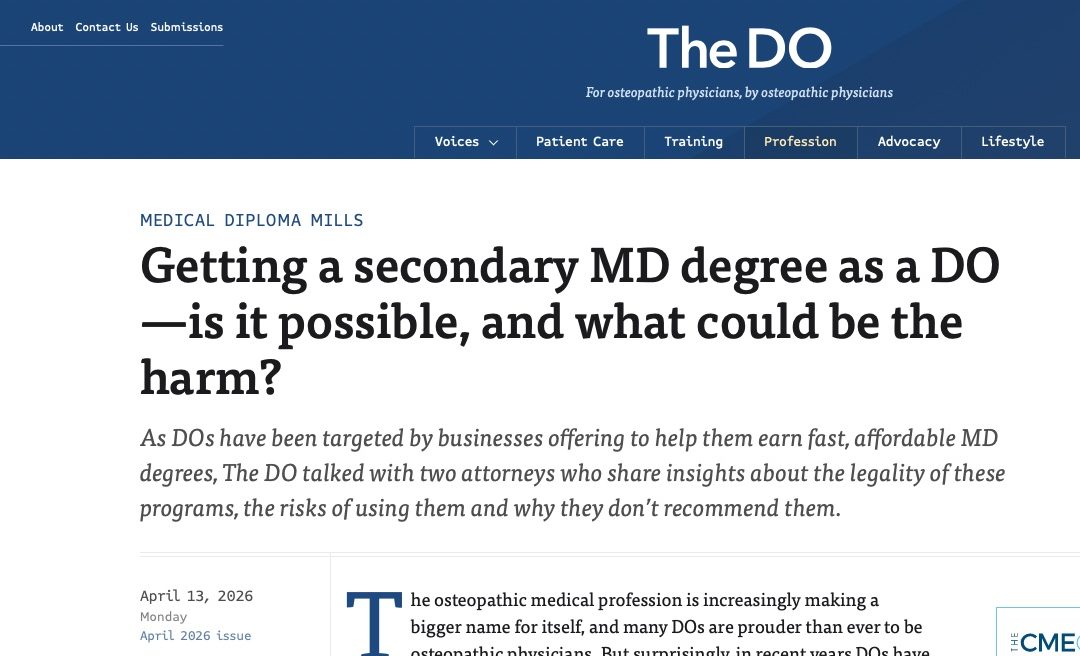
Source: https://thedo.osteopathic.org/2026/04/getting-a-secondary-md-degree-as-a-do-is-it-possible-and-what-could-be-the-harm/ (accessed May 6, 2026).
Clarity in Physician Credentials: A Patient-Centered Framework
Recent discussions in The DO, including the April 13, 2026, article “Getting a secondary MD degree as a DO—is it possible, and what could be the harm?”, raise important and legitimate concerns about credential representation, professional integrity, and public trust. These concerns are well-founded and deserve careful engagement. The article appropriately emphasizes the risks associated with fraudulent or misleading credential use, particularly in relation to unaccredited degree-granting entities. The legal analysis is grounded in those contexts and does not fully address approaches that focus on clarifying how accurate credentials are interpreted by patients.
At Saints Cosmas and Damian Health Sciences College, we begin from a point of agreement: physician credentials must be accurate, transparent, and fully aligned with licensure and training. Nothing in our pathway approach alters that commitment.
What Does Not Change
Doctors of Osteopathic Medicine (DOs) in the United States are fully licensed physicians. They complete rigorous medical education accredited by COCA, pass national licensing examinations (COMLEX-USA or USMLE), complete ACGME-accredited residency programs, and are licensed by state medical boards under the same legal framework as MD physicians.
Accordingly:
- Licensure remains unchanged
- Scope of practice remains unchanged
- Degree designation remains unchanged
- Economic situations remain unchanged
- Professional accountability remains unchanged
The DO degree remains the physician’s sole earned medical credential. No additional academic degree is conferred, implied, or substituted.
The Established Reality: Practice Equivalence
Over the past several decades, U.S. medical education and regulation have converged in a way that leaves little ambiguity about clinical equivalence. The American Osteopathic Association (AOA), the Accreditation Council for Graduate Medical Education (ACGME), and the American Association of Colleges of Osteopathic Medicine (AACOM) formally implemented a single accreditation system for graduate medical education, completed in 2020. Under this system, DO and MD graduates train in the same residency programs, under identical standards and evaluation frameworks.
Similarly, the Federation of State Medical Boards recognizes both COMLEX-USA and USMLE as valid pathways to licensure, and the National Board of Osteopathic Medical Examiners confirms the equivalency of these licensing routes.
In practice, DO and MD physicians are functionally equivalent in training, licensure, and scope of care.
Practice equivalence does not automatically produce equivalent recognition. This distinction is central to understanding the problem.
The Remaining Challenge: Patient and Global Understanding
Despite regulatory equivalence, patient confusion persists. In clinical settings, physicians frequently encounter questions about the meaning of the “DO” designation. This is not a reflection of clinical competence but of public familiarity. As reported in an April 13, 2025, New York Times article, professional education efforts over the decades have had little impact. As physician mobility increases and patient-facing interactions become more time-constrained, the gap between credential equivalence and public understanding becomes more visible.
The issue becomes more pronounced internationally. In global settings, credential recognition often precedes credential explanation. In many countries, “DO” is not recognized as a fully licensed physician designation, but is instead associated with non-physician osteopathic practitioners. As a result, U.S.-trained DO physicians may encounter misunderstanding despite holding credentials equivalent to MD-trained colleagues.
This is fundamentally a communication problem—not an educational or clinical one. In practice, communication occurs in seconds, not in explanations.
This is not the first time the profession has addressed a similar problem between credential meaning and public understanding. Over time, osteopathic medicine itself adopted the expanded designation “Doctor of Osteopathic Medicine” in place of “Doctor of Osteopathy” to more clearly communicate that DOs are fully trained physicians. That evolution did not change licensure or scope of practice; it clarified them for patients and the public, near and far. While not identical, the comparison is instructive: communication, not licensure, changed.
A Clarity Framework, Not a Credential Change
Our initiative addresses this continuing gap through what we describe as a clarity framework.
This framework does not create, alter, or replace any credential. It does not confer an MD degree, does not modify licensure, and does not expand scope of practice. Instead, it provides a structured, transparent way for physicians to communicate their already verified qualifications in terms that are more immediately understood by patients and global audiences.
Operationally, this framework is limited to supplemental, explanatory language used alongside a physician’s legally recognized credentials. For example:
- A physician continues to identify professionally as “Jane A. Smith, DO”
- Supplemental materials (such as international CVs, institutional biographies, or explanatory statements) may include clarifying language such as:
“U.S.-trained physician (DO), fully licensed and trained under standards equivalent to MD physicians.”
At no point is a physician represented as holding a degree not formally conferred. The DO designation remains primary, accurate, and unchanged. The framework is designed to reduce misunderstanding, not to introduce new ambiguity.
Why This Is Not a Diploma Mill
The term “diploma mill,” as defined by the Higher Education Act and described by the Council for Higher Education Accreditation, refers to entities that issue academic degrees without requiring legitimate education or that misrepresent credentials as equivalent to accredited degrees.
That definition does not apply here.
- No academic degree is awarded
- No accredited educational pathway is bypassed
- No credential is created or substituted
- Participation is limited to already licensed U.S. physicians with verified training
A diploma mill fabricates credentials. This model clarifies the meaning of credentials already earned and independently verified. Diploma mills obscure provenance; this framework makes provenance explicit.
Legal and Professional Boundaries
We fully recognize that the use of professional titles is governed by state medical practice acts and consumer protection laws. Any representation that misleads patients regarding licensure or credentials would be inappropriate and potentially unlawful.
For that reason, the clarity framework is explicitly constrained:
- It does not authorize the equivalent use of “MD” where not earned
- It does not permit substitution of degree designations
- It does not alter how physicians identify themselves in licensure or regulatory contexts
Physicians are advised, as a matter of prudence, to consult health care regulatory counsel regarding any public-facing use of explanatory language, particularly in jurisdictions with strict rules governing professional representation.
Why Clarity Matters
Health care depends on trust, and trust depends on understanding. When patients clearly understand who their physician is and what their qualifications represent, confidence in care improves.
Clarity has practical implications:
- Patient experience: reduces hesitation and confusion
- International mobility: improves recognition across jurisdictions
- Administrative efficiency: supports accurate credential interpretation
Improving clarity does not diminish professional identity. It reinforces it by ensuring that established equivalence is understood, not merely asserted.
Conclusion
The question is not whether DO and MD physicians are equivalent in their ability to provide care. In the United States, that question has been answered—through accreditation, licensure, and daily clinical practice.
The remaining question is how that reality is communicated.
Saints Cosmas and Damian Health Sciences College proposes improving how existing credentials are understood—without creating or implying a new credential or standard.
Clarity is not cosmetic. It is a necessary component of trust, particularly in a global and increasingly mobile medical profession.