
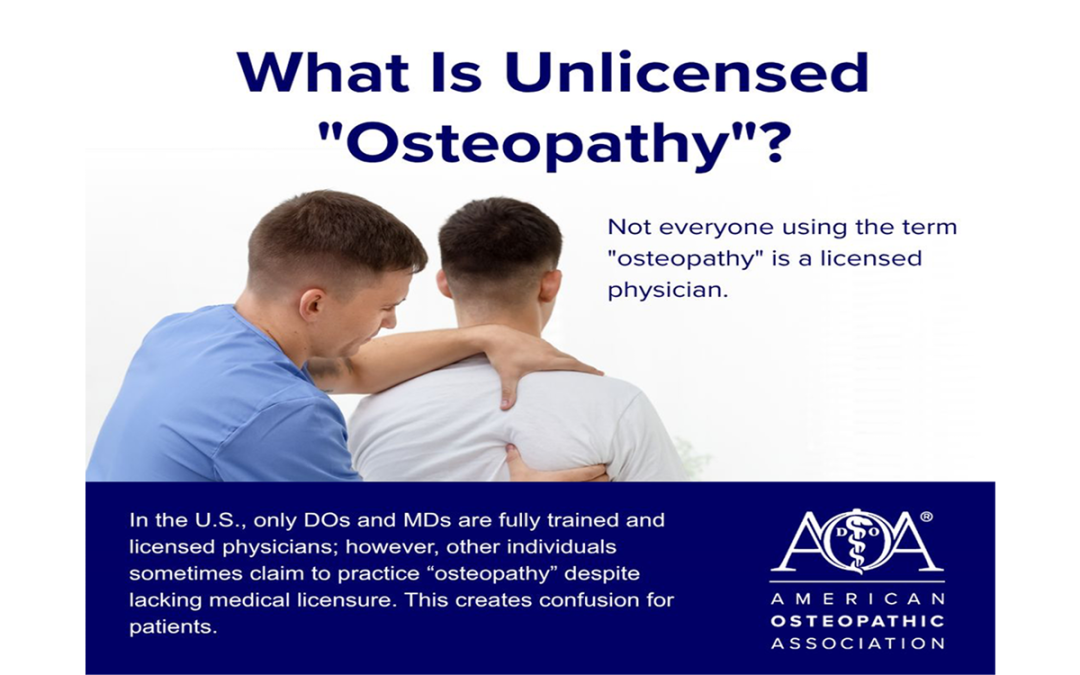
Source: American Osteopathic Association. See https://osteopathic.org/about/advocacy/state-advocacy-initiatives/protecting-osteopathic-distinctiveness/ (accessed June 30, 2026).
When a patient meets a provider whose name ends in “DO,” a fair question follows: what does that mean? The US osteopathic profession has worked for over a century to make the answer simple — yet for the patient it remains stubbornly unclear.
At home, the American Osteopathic Association (AOA) delivers a confident, well-earned message: a Doctor of Osteopathic Medicine (DO) is a fully licensed physician, equal to a Doctor of Medicine (MD) in training, licensure, and practice rights. The manipulative techniques that once defined the profession are, in this account, an added skill — not a boundary. The intended takeaway is plain: your DO is your physician.
Even that skill no longer belongs to DOs alone. The AOA itself recognizes that MDs with osteopathic training may use manual osteopathic treatments within the scope of their licenses. The signature technique cannot tell a patient who stands before them: an MD may practice it, and a DO may never touch it.
Abroad, the message must shift. To win recognition from international bodies, the AOA has worked — successfully — to have US-trained DOs classified as medical doctors, expressly distinct from the non-physician “osteopaths” who practice manual therapy under the same name across most of the world. It concedes what the domestic message cannot: that “osteopath,” to most of the globe, does not mean physician.
That foreign meaning is no longer only foreign. A growing cohort of non-physician “osteopathic manual practitioners” — trained outside medicine, unlicensed to practice it — now offers hands-on “osteopathy” in American communities. The AOA has rightly moved to protect patients, urging states to separate licensed physicians from the unregulated practice of “osteopathy.” But the campaign’s necessity is the tell: the confusion the AOA answers abroad has arrived at home, and the only line it can draw is licensure — never technique, never the shared word.
Caught most acutely are the US DOs who practice osteopathic manipulative medicine exclusively. By license, they are unquestionably physicians; yet to a patient, their work can be hard to distinguish from the very non-physician osteopathy — now practiced down the street — that the profession sets aside.
Perhaps the profession already senses the remedy. In honoring its founder, the AOA identifies him as “Andrew Taylor Still, MD, DO” — reaching, in its most reverent moment, for the compound identifier that reads as physician instantly, at a glance. If the confusion is lexical, the remedy can be too: a recognized “DO, MD” marker of physician equivalence might let patients read what the license already guarantees. No patient should have to wonder whether the doctor before them is a physician.