
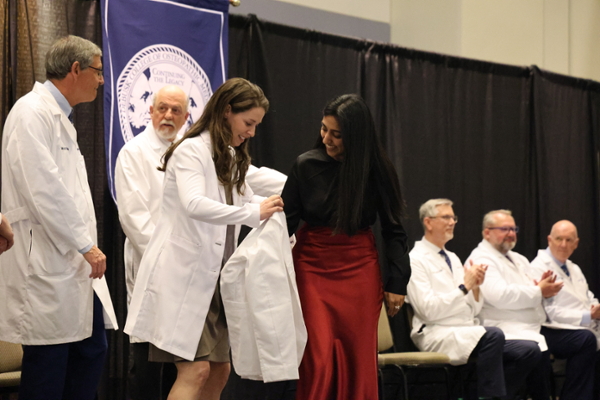
Source: Whitney Good, “LMU-DCOM Marks Milestone for Medical Students During White Coat Ceremony.” Lincoln Memorial University, April 1, 2026. https://www.lmunet.edu/news/2026/04/DCOMClassOf2028WhiteCoat (accessed November 16, 2026).
For most osteopathic medical students, the white coat ceremony marks the day a lifelong ambition became real. Whatever other doors stayed closed, a college of osteopathic medicine said yes. That debt of gratitude is genuine, and it deserves respect.
But gratitude for an open door is not the same as loyalty to a doctrine. The evidence suggests that what graduate doctors of osteopathic medicine (DOs) carry forward from school is a commitment to doctoring itself.
At Lincoln Memorial University’s DeBusk College of Osteopathic Medicine, students’ identification with osteopathy fell between matriculation and graduation in every one of eight classes studied, by 10 to 21 percent. At entry, identification was most closely tied to a strong motivation to serve the community (1). In a 2018 national survey of osteopathic physicians, 57 percent of respondents used osteopathic manipulative treatment on none of their patients, and nearly 78 percent used it on fewer than 5 percent (2). The American Osteopathic Associations’s (AOA’s) own budget figures point the same way. When it cut regular dues by $90 in 2018, it projected a $2,329,000 annual decline in revenue from full-dues-paying members (3). That works out to roughly 26,000 physicians, at a time when AOA membership was still required to keep AOA board certification (4). Members paying discounted rates are not included, so the true number of paying members was somewhat higher.
None of this is a story of disloyalty. It is a story of success. Osteopathic medical graduates wanted to become physicians, and they did. They train in the same residencies as allopathic physicians (MDs), increasingly sit for the same specialty boards, and care for the same patients. They deliver babies, staff emergency departments, and keep rural clinics open. Many now lead departments, hospitals, and health systems. Their loyalty went where it belongs: to the people in the exam room.
That outcome is not a departure from osteopathic history. As early as 1899, J. Martin Littlejohn, MD, DO, urged that osteopathic graduates be recognized by the public as physicians (5). Today’s DOs have achieved what he hoped for. They are doctors of osteopathic medicine, licensed to practice medicine—medical doctors.
Gratitude still shows, just in different places. DOs precept students from their own colleges, teach residents, volunteer at alumni events, and encourage young people who want what they once wanted. That is loyalty too, and it is loyalty to people rather than to a label.
The question for organized osteopathic medicine is whether it can celebrate that achievement rather than treat it as erosion. A profession can honor its colleges, its founders, and its distinctive training while accepting that most graduates simply wanted to practice medicine well. Gratitude can be returned in kind, by supporting graduates’ freedom to describe themselves in ways patients understand. Gratitude and candor are not rivals; graduates can cherish their colleges and still use the words patients recognize.
Patients do not need a doctrine. They need a doctor. Every year, osteopathic colleges give thousands of new physicians the chance to be exactly that. That is worth being proud of, and worth saying plainly.
Mixed messages contribute to patient confusion.
References
1. Kauffman ZS, Harper T, Augustyniak RA, Ruff C. Why is identification with osteopathy decreasing in medical students? J Osteopath Med. 2026;126(3):139-145. doi:10.1515/jom-2024-0197.
2. Healy CJ, Brockway MD, Wilde BB. Osteopathic manipulative treatment (OMT) use among osteopathic physicians in the United States. J Osteopath Med. 2021;121(1):57-61. doi:10.1515/jom-2020-0013.
3. American Osteopathic Association House of Delegates. Resolution H-701-A/2018: AOA annual dues for regular members. American Osteopathic Association. https://osteopathic.org/index.php?aam-media=%2Fwp-content%2Fuploads%2FH701-A2018-AOA-ANNUAL-DUES-FOR-REGULAR-MEMBERS-BOT-FC-3.pdf (accessed November 2, 2026).
4. AOA settles class-action lawsuit. The DO. July 27, 2018. https://thedo.osteopathic.org/2018/07/aoa-settles-class-action-lawsuit/ (accessed November 2, 2026).
5. Littlejohn JM. Osteopathy in line of apostolic succession in medicine. J Osteopath. 1899;5:421-431.