
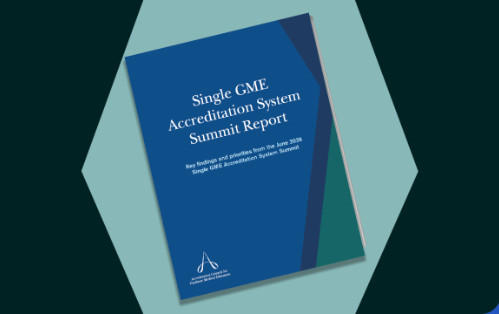
Source: Accreditation Council for Graduate Medical Education. Single GME Accreditation System Summit Report. ACGME; 2026. https://www.acgme.org/globalassets/pfassets/publicationspapers/singlegmeaccreditsysreport2026.pdf (accessed November 1, 2026).
Euclid’s first common notion holds that things equal to the same thing are equal to each other (1). Organized osteopathic medicine has spent the past decade proving that proposition about its licensing examination. It may not like where the proof leads.
In October, the Accreditation Council for Graduate Medical Education (ACGME) released the report of its June summit on the single accreditation system (2). Participants reached a clear consensus that requiring osteopathic medical students to take both the Comprehensive Osteopathic Medical Licensing Examination of the United States (COMLEX-USA) and the United States Medical Licensing Examination (USMLE) “must not continue” (3). The National Board of Osteopathic Medical Examiners (NBOME) welcomed the finding (3). In August, the Association of Program Directors in Surgery endorsed treating COMLEX-USA as equivalent to the USMLE for DO applicants (4).
Both national licensing examinations lead to the same place. Every state medical board accepts one or the other, and the license that results is for the general, undifferentiated practice of medicine (5). Two examinations equal to the same license are equal to each other.
That is the difficulty. The osteopathic organizations want equivalence in residency selection and distinctiveness everywhere else. The summit’s remedy is “universal acceptance of degree specific assessments” (3), a phrase that keeps two examinations, two testing bodies and two fee schedules in place. It asks nothing of the NBOME: no common score scale, no concordance table, no single examination (2).
The duality is not free. Passing COMLEX-USA Level 1 and Level 2-CE is required for graduation from every college of osteopathic medicine (6), at $745 for each examination (7), with Level 3 to follow in residency. In recent years 40% to 60% of DO students have also taken one or more USMLE examinations (3). The NBOME itself has estimated that the added testing costs DO students more than $5 million a year (8).
The most efficient remedy is not a campaign aimed at several thousand residency programs. It is one sentence in an accreditation standard. The Liaison Committee on Medical Education (LCME), which accredits MD programs, does not require MD students to pass the USMLE; accreditation makes them eligible to sit for it (9), and each school sets its own graduation policy. The Commission on Osteopathic College Accreditation (COCA), the American Osteopathic Association’s accreditor for colleges of osteopathic medicine, instead names the examination. Element 11.4 of its continuing accreditation standards, which govern every accredited college, requires all students to pass COMLEX-USA Level 1 and Level 2 before graduation (10). The same element ties a college’s growth to COMLEX-USA results: a college whose first-time pass rate falls well below its peers may not seek a class-size increase or a new campus for three years (10). COCA’s standards for new and developing colleges carry a parallel element (11). Amending both to require passage of a national licensing examination sequence accepted by state medical boards, and to measure outcomes on whichever sequence students take, would place osteopathic colleges on the same footing as MD schools. Colleges and students would choose. Most would probably choose the USMLE, which will continue regardless, because nearly every MD graduate and international medical graduate (IMG) needs it for licensure, and many MD schools also require it for promotion or graduation. Neither MD nor IMG students may sit for the osteopathic examination.
Four objections deserve direct answers.
The first is distinctiveness. Changing the examination would not change the curriculum. COCA Element 6.6 would still require instruction in osteopathic principles and practice in every year of the curriculum (10), and the NBOME has already shown how to verify a skill without a licensing examination: its new Comprehensive Competency Verification pathway rests on verification by the college itself (12). What a college can verify for clinical skills, it can verify for manipulative treatment.
The second is self-regulation. One might argue that the USMLE is an allopathic examination and that DOs would surrender control of their own standard. The USMLE is co-owned by the Federation of State Medical Boards (FSMB), which represents the state medical and osteopathic boards alike (13). The license is issued by the state, not the profession. Licensure is a public function; a separate examination is a professional preference.
The third is harm to the NBOME. Any amendment abolishes nothing. Any college could continue to require COMLEX-USA, and any student could take it. What ends is a guaranteed market created by an accreditor within the same profession. Such ties may even implicate federal antitrust laws. The profession has been there before: in 2017 a federal court allowed plaintiff DOs to proceed with a Sherman Act claim that the American Osteopathic Association (AOA) had unlawfully tied board certification to annual association membership (14), and the association later settled in an agreement valued at $84 million that ended the requirement (15). An accreditation standard exists to protect students and the public, not a sponsor’s revenue. If COMLEX-USA is as valid as the profession says, it can compete on that merit.
The fourth is disruption. Nearly half of DO students already prepare for and take the USMLE. A phased effective date would protect students already enrolled.
The harder question is the one the summit did not ask: does the duality serve patients? A patient seeing a newly licensed physician is protected by the license, the residency, and board eligibility and certification. Whether that physician passed COMLEX-USA or the USMLE tells the patient nothing. What patients do encounter is confusion about the letters after the physician’s name, a confusion that decades of campaigns for osteopathic distinctiveness have not cured.
Equivalence is now the profession’s own argument. Euclid suggests that it be followed to its conclusion, and COCA holds the key: one amended element would end the need for a second licensing examination. What patients are owed is a competent physician, clearly identified. What students are owed is one examination, not two.
References
1. Euclid. The Thirteen Books of Euclid’s Elements. Heath TL, trans. Vol 1. 2nd ed. Cambridge University Press; 1926. Book I, Common Notion 1.
2. Accreditation Council for Graduate Medical Education. Single GME Accreditation System Summit Report. ACGME; 2026. https://www.acgme.org/globalassets/pfassets/publicationspapers/singlegmeaccreditsysreport2026.pdf (accessed November 1, 2026).
3. National Board of Osteopathic Medical Examiners. Single GME Accreditation Summit calls for removal of barriers facing osteopathic medical students. Published October 29, 2026. https://www.nbome.org/news/single-gme-accreditation-summit-calls-for-removal-of-barriers-facing-osteopathic-medical-students/ (accessed November 1, 2026).
4. National Board of Osteopathic Medical Examiners. Momentum builds across surgical specialties for COMLEX-USA acceptance for DO applicants. Published August 4, 2026. https://www.nbome.org/news/momentum-builds-across-surgical-specialties-for-comlex-usa-acceptance-for-do-applicants/ (accessed November 1, 2026).
5. Federation of State Medical Boards. About physician licensure. https://www.fsmb.org/u.s.-medical-regulatory-trends-and-actions/guide-to-medical-regulation-in-the-united-states/about-physician-licensure/ (accessed November 1, 2026).
6. American Association of Colleges of Osteopathic Medicine. Medical board examinations and licensure. https://www.aacom.org/become-a-doctor/succeed-in-medical-school/board-examinations-and-licensure (accessed November 1, 2026).
7. National Board of Osteopathic Medical Examiners. Frequently asked questions: what fees are associated with COMLEX-USA? https://www.nbome.org/frequently-asked-questions/#what-fees-are-associated-with-comlex-usa (accessed November 1, 2026).
8. National Board of Osteopathic Medical Examiners. The NBOME continues research on need for holistic review by RPDs, offers new tool for licensure score comparison. Published February 14, 2022. https://www.nbome.org/news/concordance-comlex-usmle-scores/ (accessed November 1, 2026).
9. Liaison Committee on Medical Education. Frequently asked questions. https://lcme.org/faqs/ (accessed November 1, 2026).
10. Commission on Osteopathic College Accreditation. Accreditation of Colleges of Osteopathic Medicine: COM Continuing Accreditation Standards. American Osteopathic Association; February 1, 2026. Effective July 1, 2026. https://osteopathic.org/wp-content/uploads/COCA-2026-COM-Continuing-Accreditation-Standards.pdf (accessed November 1, 2026).
11. Commission on Osteopathic College Accreditation. Accreditation of Colleges of Osteopathic Medicine: COM New & Developing Accreditation Standards. American Osteopathic Association; February 1, 2026. Effective July 1, 2026. https://osteopathic.org/wp-content/uploads/COCA-2026-COM-New-and-Developing-Accreditation-Standards.pdf (accessed November 1, 2026).
12. National Board of Osteopathic Medical Examiners. NBOME announces the next phase of innovation in clinical skills competency assessment for COMLEX-USA. Published June 26, 2026. https://www.nbome.org/news/nbome-announces-the-next-phase-of-innovation-in-clinical-skills-competency-assessment-for-comlex-usa/ (accessed November 1, 2026).
13. United States Medical Licensing Examination. About the USMLE. https://www.usmle.org/about-usmle (accessed November 1, 2026).
14. Talone v American Osteopathic Association, No. 1:16-cv-04644-NLH-JS, 2017 WL 2539394 (D NJ June 12, 2017). https://www.govinfo.gov/content/pkg/USCOURTS-njd-1_16-cv-04644/pdf/USCOURTS-njd-1_16-cv-04644-0.pdf (accessed November 1, 2026).
15. Duane Morris LLP. Osteopathic physicians class action. https://www.duanemorris.com/site/osteopathclassaction.html (accessed November 1, 2026).