
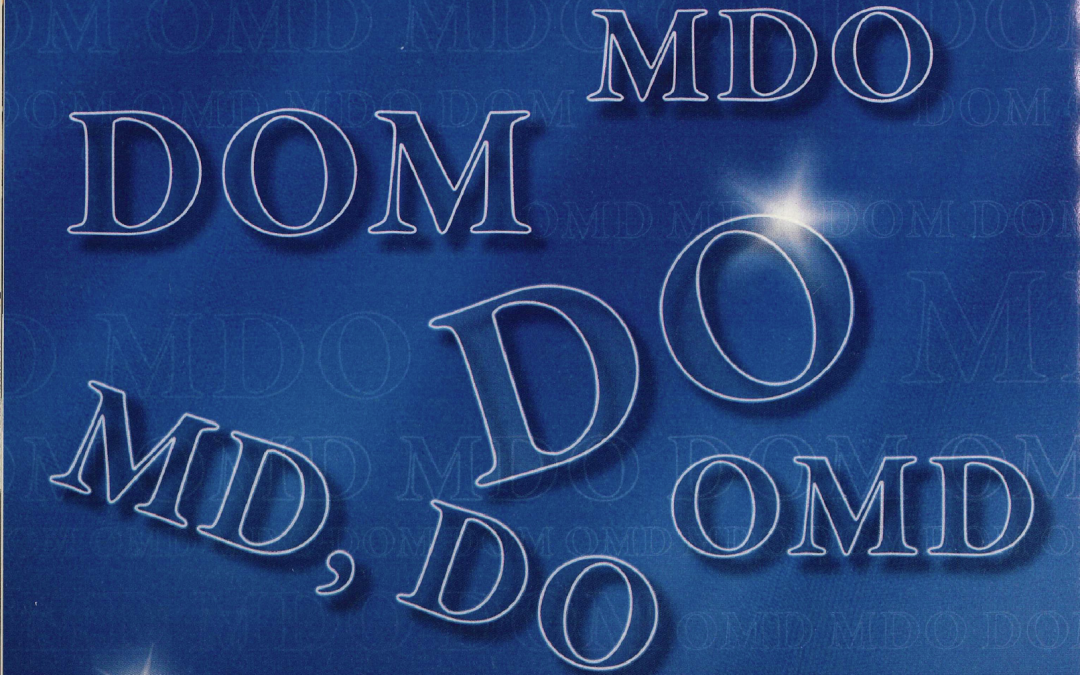
Source: Greenwald B. Letter perfect: can a new degree lead to more respect, recognition for DOs? The DO. 2008;48(2):30-34.
In February 2008 the American Osteopathic Association’s (AOA’s) magazine, The DO, asked whether a new degree designation could bring osteopathic physicians more recognition.1 The article was written because the then AOA president’s blog posts on the subject had drawn almost 200 comments.1 Readers proposed DOM, OMD and MDO, and some wanted “the credentials MD, DO.”1 None of it was new.
The first proposal came from inside the movement’s founding school. In February 1899 J. Martin Littlejohn, dean of the American School of Osteopathy, told a graduating class that osteopaths stood “in lineal and legitimate descent” from the physicians of every age, and predicted that “the Doctorate in Medicine will be the appropriate title of the Osteopath as well as the Allopath.”2 The school’s charter already allowed it to confer the degrees “usually granted and conferred by reputable medical colleges.”2 That spring the faculty resolved that the school should confer the Doctor of Medicine under the title “MD (Osteopathic)” and sent the resolution to the trustees “with the strongest recommendation of the faculty.”2 Andrew Taylor Still answered in September: “We want no M.D.O. in our school,” because “D.O. means just what it stands for, Diplomate in Osteopathy.”2 Littlejohn was removed as dean, and he and his brothers left to found a college of their own in Chicago.2
The idea outlived the quarrel. In 1934 Guy Loudon, DO, told a Vermont county society that osteopathic physicians were “handicapped through the imperfect understanding of our merits by the public.” He wanted the degree changed to MD, DO, and called the MD designation the “key to the secret chamber of opportunity.”1
In the early 1960s about 2,000 California DOs accepted MD degrees in a merger with organized medicine.3 A decade later a magazine, The Osteopathic Physician, polled the profession. In 1971, 41% of responding DOs favored having the schools grant a DO-MD degree. In 1972, 68% of responding students did.3 The magazine’s editor, J. Dudley Chapman, DO, pointed to a study in which physicians and patients ranked “osteopath” 37th of 41 health occupations in prestige. “Our image is miserable,” he wrote, and a DO-MD degree “would solve the street corner problem.”3 A federal court took the other view in 1973. Ruling against a Georgia DO who claimed unequal treatment, it said his remedy lay “chiefly in a concerted effort by him and other osteopaths to educate the public.”3 In 1994, the AOA let colleges print “Doctor of Osteopathic Medicine” on their diplomas. The words changed. The letters did not.3
Anthony J. Silvagni, DO, PharmD, dean of the osteopathic college at Nova Southeastern, made that point in the same magazine in June 2008: “our DO letters did not change.”4 He wrote that after more than 100 years “most people still do not recognize” the degree, and that this was so “after the profession has spent countless dollars to publicize itself.”4 He proposed OMD and pointed to pharmacy, podiatry and law, each of which had changed its letters.4
The profession’s answer was to wait. Boyd Buser, DO, then the AOA’s first vice president, said, “The real problem is not the initials,” and predicted that “as our numbers grow, the public’s perception of what a DO is will sharpen.”1Historian Norman Gevitz projected that DOs would be 25% of US medical graduates by 2017.1 That July the House of Delegates voted unanimously to keep DO as the sole degree.3
The numbers grew as forecast. The perception did not sharpen. On September 30, 2026, Scripps Health revised a patient page that still explains what the letters mean, and the same page reports that more than 25% of US medical students now study osteopathic medicine.5 It quotes a DO saying, “We have the same profession and role, just different degrees,” and then advises patients on which type of doctor—DO or MD—to choose.5
The mixed message is as old as the question. Littlejohn called osteopathy a school of medicine; Still called his school “strictly Osteopathic.”2 In 2008 a student who wanted a change said DOs “do everything MDs do but with a plus,” while a dean told his students they should not be saying “DOs are just like MDs.”1 The AOA’s 2026–2029 strategic plan carries both halves forward: it promises wider public awareness and declares that “our distinctiveness rests on evidence as well as philosophy.”6
The question was put in 1899, 1934, 1971 and 2008, and it is put again in 2026 by every hospital web page that explains the letters. Each time the profession has kept the initials and promised to educate the public. A profession that tells patients its physicians are equal, and tells itself they are distinct, will keep being asked which it is. Growth has not settled the question, and another awareness campaign probably will not either.
References
1. Greenwald B. Letter perfect: can a new degree lead to more respect, recognition for DOs? The DO. 2008;48(2):30-34.
2. Gevitz N. The “diplomate in osteopathy”: from “school of bones” to “school of medicine.” J Am Osteopath Assoc. 2014;114(2):114-124. doi:10.7556/jaoa.2014.025
3. Gevitz N. From “doctor of osteopathy” to “doctor of osteopathic medicine”: a title change in the push for equality. J Am Osteopath Assoc. 2014;114(6):486-497. doi:10.7556/jaoa.2014.099
4. Silvagni AJ. DO to OMD: is it right? The DO. 2008;49(6):13-14.
5. Scripps Health. MD vs DO: what’s the difference when choosing a doctor? December 1, 2025. Updated September 30, 2026. https://www.scripps.org/news_items/4898-md-vs-do-what-s-the-difference-when-choosing-a-doctor (accessed October 5, 2026).
6. Creason KS. Your journey. Our shared commitment: the road ahead for our profession. The DO. July 27, 2026. https://thedo.osteopathic.org/2026/07/your-journey-our-shared-commitment-the-road-ahead-for-our-profession/(accessed October 5, 2026).