
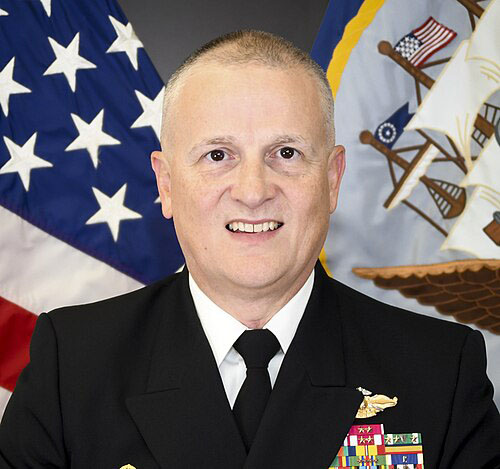
Sean Patrick Barbabella, DO, Physician to the President, Captain, US Navy. Source: Official portrait, 2023, Executive Office of the President.
For seventy years the osteopathic profession argued that its graduates (DOs) were physicians. For seventy years organized medicine (MDs) answered that they were cultists.1,2 The argument was never won. A federal government that needed doctors and had no stake in the professional quarrel made the dispute irrelevant.
The case could be made, though, that MDs had ulterior motives. In 1955, the American Medical Association’s (AMA’s) own inspectors—sitting and former deans of allopathic medical schools who had visited five of the six osteopathic colleges—reported deficiencies but no evidence of cultism and recommended dropping the label. After floor debate, the House of Delegates rejected the report of its own experts by 101 to 81.3 The finding was not disputed; it was outvoted. Six years later, the Judicial Council reaffirmed that osteopathy was cult healing.2 Evidence was never the currency in which this question was settled.
Nor was the inability to secure physician status nationally due to lack of effort. In 1917, Representative Addison Smith of Idaho introduced HR 5407 to admit osteopathic physicians to the Army and Navy medical services at equal rank. Surgeon General William Gorgas, relying on the Flexner Report, opposed it; when twenty-five DOs sat for the medical examination the Army had opened to graduates of unaccredited allopathic and homeopathic schools, the first fifteen scores reported were passing, the applicants were told they remained ineligible, and the remaining ten scores were never released.4 The profession answered with the largest public-opinion campaign it would ever mount: 33,000 letters to Congress from California on the first day alone, more than 180,000 pieces delivered in all against a hoped-for million.5The bill died in committee. What did move the profession’s standing that season was the influenza pandemic, which put DOs in front of patients MDs could not reach and expanded osteopathic practice from chronic complaints to acute illness.6 Persuasion produced a hearing. Need produced patients.
The Second World War repeated the lesson in a form that should have been unmistakable. Congress had by then made the MD and DO equivalent for licensure in the District of Columbia (1929), declared DOs “physicians” under the Federal Compensation Act (1938), authorized intern pay for graduates of “reputable schools of medicine or osteopathy” (1941), and appropriated funds to commission DOs as naval medical officers (1942). None of it mandated a policy change, and both services continued to accept only MD graduates of AMA-accredited colleges.7 Meanwhile, Major General Lewis Hershey’s Selective Service System judged osteopathic physicians essential to the civilian war effort and inducted comparatively few of them. DOs filled the void left by deployed MDs and took on hundreds of thousands of new patients; barred from allopathic hospital staffs, they and their patients built dozens of hospitals of their own.8 Exclusion from the military manpower pool was itself a manpower allocation—and it built the institutional base that the federal government would later have no choice but to recognize.
The pattern is clearest in what did not happen next. Public Law 604, enacted in 1946, gave the President express permanent authority to appoint graduates of osteopathic medical schools as medical officers of the Navy.9 Facing a physician shortage during the Korean War, President Harry S Truman declined to use it. For the native Missourian, the manpower need was real; the political cost of defying the AMA was higher—and by 1951 the AMA sat as a constituent member of the Joint Commission on the Accreditation of Hospitals, which accredited military hospitals and approved the postgraduate programs the surgeons general depended on.10,11 Nothing about osteopathic training changed between then and 1966. What changed was the price of deference.
Congress tried to force the question in 1956. Before a subcommittee of the Senate Armed Services Committee on HR 483, the Department of Defense’s own witness, Deputy Assistant Secretary Edward H. Cushing, MD, argued the case in exactly these terms: there was a shortage of military physicians, and making DOs eligible would broaden the pool of qualified candidates. The surgeons general answered with four objections—recruitment and retention of MDs, approval of allopathic postgraduate programs, accreditation of hospitals, and morale.12 Not one of them was clinical. Surgeon General Silas Hays read into the record a subordinate’s letter promising to resign “the day the Army mongrelizes the medical profession by commissioning osteopaths as equal doctors of medicine,” and Senator Henry Jackson answered that this was bigotry of the same kind then being defended in the segregated schools. The bill passed, and President Eisenhower signed it.13 Then nothing happened for a decade, because the surgeons general declined to implement it. A statute the government does not yet need is a dead letter.
By 1963, the federal calculation had shifted. Responding to projected national shortages, Congress passed the Health Professions Educational Assistance Act, which President John F. Kennedy signed on September 24. The statute, which had broad bipartisan support, authorized construction grants and student loans, and its construction section named osteopathic teaching facilities alongside medical, dental, pharmaceutical, optometric, podiatric, nursing, and public health ones.14 Kennedy’s signing remarks spoke of students undertaking careers in medicine, dentistry, and osteopathy.15,16 That same year, the US Civil Service Commission, citing the recent California merger agreement, announced that for its purposes the MD and DO were to be deemed equivalent degrees.2
The timing is worth noting. The profession was then at its institutional nadir: only five accredited colleges, its largest state division gone after the California merger converted roughly two thousand of that state’s twenty-three hundred DOs to MDs for sixty-five dollars apiece, and the AMA Judicial Council having reaffirmed in 1961 that osteopathy was cult healing.1,2,17 Federal recognition arrived not because the profession was strong but because the government’s need was greater.
Medicare and Medicaid made the logic unavoidable. A universal entitlement cannot carry a discriminatory provider definition. Title XVIII’s physician definition covered doctors of osteopathy from enactment in 1965,18 and when the program required participating hospitals, the American Osteopathic Association (AOA) was accepted in 1966 as an accrediting agency over osteopathic hospitals—because the Joint Commission did not accredit them and Medicare could not afford to strand several hundred community facilities at the moment demand surged.1,2 Those were the hospitals that exclusion had built.
Vietnam completed the sequence. As American participation escalated, the exemption of DOs from a draft that was taking MDs drew open anger from allopathic physicians; the Camden County Medical Society enlisted Representative William Cahill of New Jersey, who told the House in March 1966 that his MD and DO constituents were of one mind in blaming both the AMA and the Department of Defense.19 On May 3, 1966, Secretary of Defense Robert N. McNamara invoked the authority granted his office a decade earlier and authorized acceptance of osteopathic physicians into all the military medical services on the same basis as MDs; the following year DOs became subject to the doctors’ draft.20
Harry J. Walter, DO, volunteered the same day the change was announced. A thirty-two-year-old general practitioner from Leawood, Kansas, just finished with his AOA internship, he took the oath of office on July 13, 1966, at Richards-Gebauer Air Force Base in Grand View, Missouri, and was sworn in as a first lieutenant—the first osteopathic physician commissioned in the Medical Corps of the armed services. He said he was pleased at the distinction but prouder that the profession had finally reached the goal, and then he put the whole fifty-year case in a sentence: “As qualified physicians, members of my profession feel we should be permitted to serve, and as Americans we want to.”21
He did not say osteopathy. Neither did the government that had finally sent for him. The fifty-year war over a word ended not because the word was at last explained, but because the country ran short of physicians and discovered that it already had thousands it had refused to count.
Notes and References
1 Gevitz N. The DOs: Osteopathic Medicine in America. 3rd ed. Baltimore, MD: Johns Hopkins University Press; 2019, 117.
2 Gevitz N. From “Doctor of Osteopathy” to “Doctor of Osteopathic Medicine”: a title change in the push for equality. J Am Osteopath Assoc. 2014;114(6):486-497.
3 Gevitz N. The sword and the scalpel—the osteopathic “war” to enter the Military Medical Corps: 1916-1966. J Am Osteopath Assoc. 1998;98(5):279-286, 283.
4 Gevitz, “The sword and the scalpel,” 280. HR 5407, introduced by Rep. Addison Smith (R-Idaho), June 1917; Gorgas’ objections rested on Flexner, Medical Education in the United States and Canada (1910).
5 Gevitz, “The sword and the scalpel,” 281.
6 Gevitz, “The sword and the scalpel,” 282.
7 Gevitz, “The sword and the scalpel,” 282, collecting the District of Columbia licensure equivalence (1929), the Federal Compensation Act designation (1938), the student deferment (1940), the Military Appropriations Act signed by President Roosevelt in June 1941, and the 1942 naval appropriation.
8 Gevitz, “The sword and the scalpel,” 283. The same page collects the postwar concessions that followed the same logic: GI Bill benefits at approved osteopathic colleges, Hill-Burton eligibility for osteopathic hospitals, Veterans Administration appointments beginning in 1947, and Public Health Service eligibility.
9 Public Law 604, 79th Cong. (1946), authorizing appointment of graduates of osteopathic medical schools as medical officers of the Navy. See Swope C. President given express permanent authority for osteopathic appointments in Navy Medical Corps. Journal of the American Osteopathic Association. 1946;46:17.
10 Gevitz, “The sword and the scalpel,” 283. The earlier draft attributed Truman’s inaction to the 1956 Act; the authority he declined to exercise was the 1946 statute at note 9. The AMA became a constituent member of the Joint Commission on the Accreditation of Hospitals in 1951.
11 Starr P. The Social Transformation of American Medicine. New York, NY: Basic Books; 1982. Starr remains the standard account of the AMA’s campaign against compulsory national health insurance, 1945-1950, at pp. 235 et seq.; he deals with the early days of osteopathy only briefly, at p. 108.
12 Appointment of Doctors of Osteopathy as Medical Officers: Hearings Before a Subcomm. of the S. Comm. on Armed Services, 84th Cong., 2d Sess., on H.R. 483 (Feb. 14 and Mar. 2, 1956). Washington, DC: US Government Printing Office; 1956. Cushing’s testimony and the surgeons general’s four objections are summarized in Gevitz, “The sword and the scalpel,” 284.
13 Act of 1956 (H.R. 483), amending the Army-Navy-Public Health Service Medical Officer Procurement Act of 1947 to provide for the appointment of doctors of osteopathy in the Medical Corps of the Army and Navy. The Hays letter and Jackson’s response are at Gevitz, “The sword and the scalpel,” 284.
14 Health Professions Educational Assistance Act of 1963, Pub. L. No. 88-129, 77 Stat. 164 (Sept. 24, 1963).
15 Kennedy JF. Statement on Signing the Health Professions Educational Assistance Act, 24 September 1963. Papers of John F. Kennedy, President’s Office Files, Speech Files, jfkpof-046-046. Boston, MA: John F. Kennedy Presidential Library and Museum. Also in Public Papers of the Presidents of the United States: John F. Kennedy, 1963.
16 The Kennedy Library folder, assembled by Evelyn Lincoln, contains both a draft and a press copy of the signing statement. A collation of the two would establish whether osteopathy was named in the original draft or added in revision—and thus whether its inclusion reflected a deliberate decision or none at all. The Library’s own catalog description of H.R. 12 mentions only medicine and dentistry; but that may be because the term “medicine” was intended to be inclusive of both osteopathic and allopathic physicians.
17 Gevitz, “The sword and the scalpel,” 284, giving the conversion figure as two thousand of approximately twenty-three hundred California DOs at sixty-five dollars.
18 Social Security Amendments of 1965, Pub. L. No. 89-97, 79 Stat. 286, § 1861(r) (definition of physician). Codified as amended at 42 U.S.C. § 1395x(r); see also 42 C.F.R. § 400.202.
19 Cahill WT. Remarks on osteopaths in military service. Congressional Record. 1966;112(Mar. 7):4805. See Gevitz, “The sword and the scalpel,” 284.
20 Gevitz, “The sword and the scalpel,” 284-285.
21 Dr HJ Walter becomes first DO to receive commission in Medical Corps of Armed Services. The DO. 1966;6(Aug):26, quoted at 26; Gevitz, “The sword and the scalpel,” 285. Accounts naming Thomas A. Quinn, DO, as the first DO to serve describe a separate event: conscription under the doctors’ draft in 1967, not voluntary commissioning. See https://aof.org/news/thomas-a-quinn-do-elected-to-american-osteopathic-foundation-board-of-directors and https://www.kansascity.edu/blog/leadership/veterans-day-message (both accessed August 25, 2026).