
In June 2025 The New York Times warned, and in an article The Boston Globe reprinted, that caps on loans to graduate and professional students could worsen the doctor shortage.(1,2) The bill then before Congress would have limited federal borrowing to $150,000 and phased out Grad PLUS, the program that let medical students borrow the full cost of attendance. The law as enacted later set the limit at $200,000; it became effective July 1, 2026.(3) The arithmetic barely changed in the new version. When the bill passed, four years at a private college of osteopathic medicine cost an average of $371,403.(1,2) On average, each student entering this academic year must now find about $171,000 somewhere else.
The finer details sharpen the problem. The annual limit is $50,000, against a yearly cost above $90,000, so the gap opens in the first semester. Also, the $200,000 limit includes any earlier graduate borrowing, so a student who financed a master’s degree first begins with less.(4) Undergraduate loans do not reduce it, though they count toward a separate lifetime limit of $257,500.(4,5) And students who were enrolled and borrowing before July 1 may keep the old rules for up to three years.(4) Only this year’s entering class is capped. The pressure will build one class at a time.
For most students, the “somewhere else” means private lenders. A borrower advocate told the reporter that private loans carry more risk and fewer consumer protections, and they do not qualify for Public Service Loan Forgiveness. Students from low-income families, the article noted, may have difficulty qualifying at all. An economist added that the private market had shrunk markedly since the Great Recession.(1,2) Admission to lower-cost state-supported medical schools is likely to become more competitive. The strain on applicants from rural and underserved areas, where family incomes are typically lower, is likely to grow.
One exchange in the article deserves more attention than it received. A House committee spokeswoman said nothing stopped schools from giving students more aid. The osteopathic colleges’ lobbyist answered that most of his schools could not: they are private and not attached to universities with foundations.(1,2)
That answer shows where the risk concentrates. A university-based medical school can lean on an endowment, a state appropriation, or a connected hospital or health system. An investor-owned school granting the Doctor of Osteopathic Medicine (DO) degree has tuition, and owners who expect a return on their investment. The American Medical Association’s education council found that tuition and fees supply about 80% of revenue at private osteopathic schools, against 14% at public ones.(6) Of the for-profit medical schools that opened in the United States between 2015 and 2021, all but one were osteopathic.(7) At one of them, students were already borrowing far more than their peers. In 2019 median program debt at Rocky Vista University was $294,780, against $201,164 at private non-profit schools.(7) The larger the debt, the larger the share a private lender must now agree to carry.
The price keeps rising while the cap doesn’t change. First-year tuition and fees at Burrell College of Osteopathic Medicine, a for-profit school in New Mexico, were $52,009 in 2018-19. They are listed at $72,597 for 2026-27, an increase of 40%.(8,9) At Rocky Vista and the Idaho College of Osteopathic Medicine, both for-profit, the rise over roughly the same years was between a fifth and a quarter.(8,10,11) Across all private osteopathic colleges, the four-year average cost climbed about $9,000 in a single year, to $380,501 in 2024-25.(12) The loan caps are not adjusted for inflation.(13) Every increase now lands on the private borrowing side of the ledger.
The for-profit Caribbean schools granting the Doctor of Medicine (MD) degree run the same model with weaker results, and a lender will notice. The federal government lent without asking whether the borrower would become a practicing physician. A private lender asks little else. Offshore Caribbean schools graduate 50% to 80% of their students on time, against 90% to 95% at US schools. A US citizen who graduates from a foreign school has roughly a 53% chance of matching to a residency, against 94% for a US graduate.(14) Median debt for those who finished at Ross University School of Medicine in Barbados was $348,601.(15) Faced with those numbers, a lender can raise the rate, require a cosigner, or decline.
Moreover, the two for-profit sectors are not strangers. Medforth Global Healthcare Education, the investor-backed company that bought Rocky Vista in 2018, also owns St. George’s University School of Medicine in Grenada.(7,16)
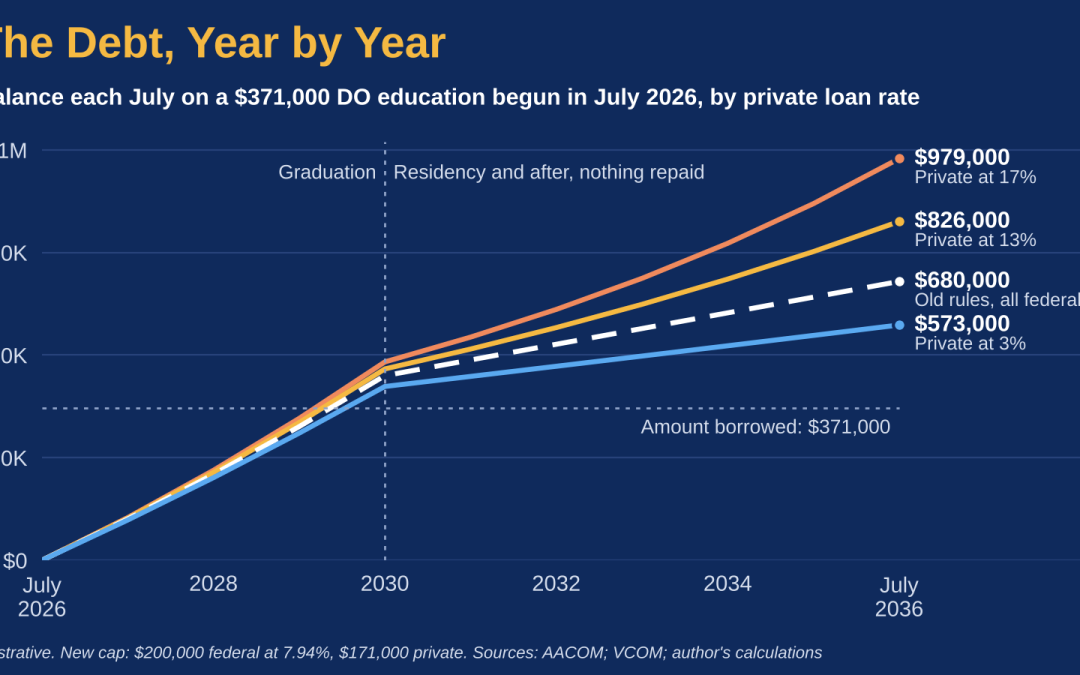
The rate a lender sets matters more than the amount. The lender working with one non-profit osteopathic college quotes 3% to 13%, and says commercial lenders reach 17%.(17) On $371,000 borrowed, with nothing repaid for six years after graduation, a student whose private share carries 3% would owe about $573,000 in 2036. At 13% the figure is about $826,000, and at 17% about $979,000. Under the old all-federal rules it would have been about $680,000. The student with good credit comes out ahead of the old system. The student without it falls far behind.
None of this is yet a record of failure. Enrollment figures for the first capped class have not been published. But the direction is clear. The cap did not end federal lending for medical school. It ended federal lending without underwriting. The schools most exposed are the ones whose revenue depended on it: those with no endowment or scholarship funds to fall back on, the highest student debt, or the outcomes a lender is least likely to trust.
References
1. Rabin RC. Trump bill’s caps on grad school loans could worsen doctor shortage. New York Times. June 9, 2025:A1. https://www.nytimes.com/2025/06/09/health/trump-budget-student-loans-doctors.html (Accessed October 10, 2026)
2. Rabin RC. Trump budget’s caps on grad school loans could worsen doctor shortage. Boston Globe. June 9, 2025. Reprinted from The New York Times. https://www.bostonglobe.com/2025/06/09/nation/trump-budgets-caps-grad-school-loans-could-worsen-doctor-shortage (Accessed October 10, 2026)
3. American Association of Colleges of Osteopathic Medicine. AACOM mitigates higher ed provisions enacted in budget reconciliation bill. July 14, 2025. https://www.aacom.org/news-reports/news/2025/07/14/aacom-mitigates-higher-ed-provisions-enacted-in-budget-reconciliation-bill (Accessed October 10, 2026)
4. Marian University Health Professions Financial Aid Office. Federal student loan changes for graduate and professional students. July 30, 2025. https://www.marian.edu/osteopathic-medical-school/_assets/_documents/bbb-one-sheeter-grad-programs.pdf (Accessed October 10, 2026)
5. Pepperdine University. OBBBA information. https://www.pepperdine.edu/admission/financialaid/obbba-info/ (Accessed October 10, 2026)
6. American Medical Association Council on Medical Education. For-Profit Medical Schools or Colleges. CME Report 1-I-19. 2019. https://www.ama-assn.org/system/files/2020-04/cme-report-1-i19-annotated.pdf (Accessed October 10, 2026)
7. Knight V. Once banned, for-profit medical schools are on the rise again in the US. Kaiser Health News. June 7, 2021. https://www.wgbh.org/news/national/2021-06-07/once-banned-for-profit-medical-schools-are-on-the-rise-again-in-the-u-s (Accessed October 10, 2026)
8. American Association of Colleges of Osteopathic Medicine. 2018-19 Osteopathic Medical College Cost of Attendance. https://www.aacom.org/docs/default-source/research-reports/2018-19-coa_pdf.pdf (Accessed October 10, 2026)
9. American Association of Colleges of Osteopathic Medicine. Burrell College of Osteopathic Medicine. College profile. https://www.aacom.org/detail-pages/com/burrell-college-of-osteopathic-medicine (Accessed October 10, 2026)
10. American Association of Colleges of Osteopathic Medicine. Rocky Vista University College of Osteopathic Medicine. College profile. https://www.aacom.org/detail-pages/com/rocky-vista-university-college-of-osteopathic-medicine (Accessed October 10, 2026)
11. American Association of Colleges of Osteopathic Medicine. Idaho College of Osteopathic Medicine. College profile. https://www.aacom.org/detail-pages/com/idaho-college-of-osteopathic-medicine (Accessed October 10, 2026)
12. American Association of Colleges of Osteopathic Medicine. 2024-25 Osteopathic Medical College Cost of Attendance. https://www.aacom.org/searches/reports/report/2024-25-osteopathic-medical-college-cost-of-attendance (Accessed October 10, 2026)
13. California Legislative Analyst’s Office. Impact of H.R. 1 on Access to Medical School and Student Debt. February 23, 2026. https://www.lao.ca.gov/handouts/health/2026/Impacts-of-HR1-on-Access-to-Med-School-and%20Debt-022326.pdf (Accessed October 10, 2026)
14. Moats A. The Hidden Loophole: How Predatory Offshore Medical Schools Are Partnering With U.S. Universities to Access Federal Student Aid Funds. Student Defense; November 2022. https://www.american.edu/spa/peer/upload/peer_hidden_loophole_d.pdf (Accessed October 10, 2026)
15. Guide to student loans for Caribbean medical schools. Student Loan Planner. https://www.studentloanplanner.com/student-loans-caribbean-medical-schools/ (Accessed October 10, 2026)
16. Seltzer R. For-profit secures accreditor’s approval for planned Montana medical school. Higher Ed Dive. July 28, 2022. https://www.highereddive.com/news/for-profit-secures-accreditors-approval-for-planned-montana-medical-school/628289/ (Accessed October 10, 2026)
17. Edward Via College of Osteopathic Medicine. Edward Via College of Osteopathic Medicine and South Carolina Student Loan team up to help students impacted by new federal loan caps. April 2, 2026. https://www.vcom.edu/news/2026/04/06/edward-college-osteopathic-medicine-and-south-carolina-student-loan-team-help-students-impacted-new (Accessed October 10, 2026)