
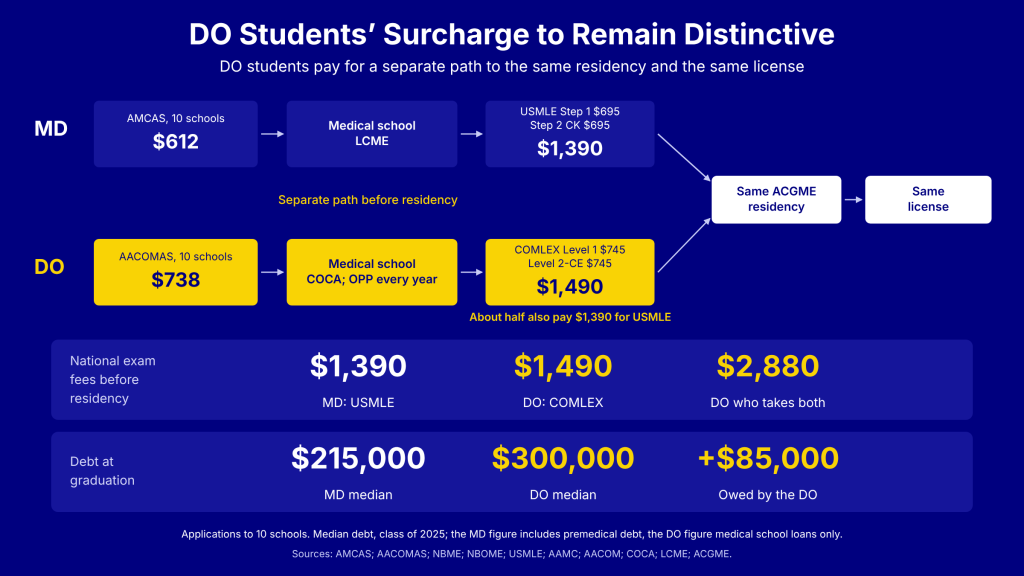
Osteopathic medicine defines itself by its difference. Its accreditor requires that every Doctor of Osteopathic Medicine (DO) student be taught osteopathic principles and practice (OPP) in each year of the curriculum, and that every college maintain a department of osteopathic manipulative medicine (OMM) led by a board-certified osteopathic physician. (1) One might ask who pays for that difference, and whether the stage of training it is built around still carries the weight it once did.
Begin with an expense students cannot avoid. To graduate, every osteopathic student must pass the Comprehensive Osteopathic Medical Licensing Examination of the United States (COMLEX-USA) Level 1 and Level 2-CE. (2) Each costs $745. (3) For one student, $1,490 may be a small sum: about half of one percent of the $300,000 median education debt reported by osteopathic graduates in 2025. (4) For the bodies that sell the examinations and process the applications, the same payments are a lifeline. The National Board of Osteopathic Medical Examiners (NBOME) reported revenue of $32.4 million in 2023, of which $30.0 million came from its programs, chiefly examinations. (5) At today’s fees, an entering class of 11,687 is committed to about $17 million in examination fees before it graduates, a figure calculated, not reported by the board. (5,6) Applicants pay the osteopathic application service (AACOMAS) $198 for the first program to which they apply and $60 for each after it, and the American Association of Colleges of Osteopathic Medicine (AACOM) drew $18.3 million of its $19.9 million in 2023 revenue from its programs. (7,8) The colleges themselves depend on students: about 80 percent of revenue at private osteopathic schools comes from tuition and fees, against 14 percent at public ones. Only seven of 42 DO colleges are public. (9,10)
Many students pay examination fees twice. In 2025, 4,744 osteopathic examinees took the US Medical Licensing Examination (USMLE) Step 1, and 5,057 took Step 2 CK in 2024–25, roughly half of a graduating class of about 9,000. (11,12) Each examination costs $695. (13) For those students, licensing examinations before graduation cost $2,880 rather than $1,490.
The DO colleges have a separate accreditation system as well. Schools granting the Doctor of Medicine (MD) degree are accredited by the Liaison Committee on Medical Education (LCME), sponsored by the Association of American Medical Colleges (AAMC) and the American Medical Association (AMA). (14) Osteopathic colleges are accredited by the American Osteopathic Association’s (AOA’s) Commission on Osteopathic College Accreditation (COCA), whose fees are set by the association’s board of trustees and billed to each college every year. (15) The two differ in who pays for a visit. The osteopathic accreditor charges no fee for a site visit, but each college reimburses the team’s travel, lodging, meals and honoraria; its planning guide puts a typical four-evaluator visit at about $22,000, a total calculated here from its estimates. (16) The LCME pays the travel expenses of full surveys once a school is established. (17) Neither accreditor publishes what accreditation costs a school, and the work each demands, a self-study and a site visit, is much the same in kind. The burden is not that one costs more than the other; it is that the medical profession maintains two. Four universities, Michigan State, Rowan, Nova Southeastern and Touro, operate both kinds of schools and so maintain both accreditations: two sets of standards and two cycles of self-study for programs whose graduates enter the same residencies. (18,19) At private colleges, where tuition and fees supply about 80 percent of revenue, such costs fall largely on students. (9)
Fairness requires a look at the MD side too. Every medical student pays national licensing examination fees; the two required COMLEX examinations cost $100 more than the two USMLE examinations an MD student takes. (3,13) No rule requires the second series. Students pay no dues to the AOA (20) The larger burden is debt. In 2025, the median osteopathic graduate owed $300,000 in medical school loans, against $215,000 for MD graduates, a figure that also counts premedical borrowing. (4,21) By that measure, an MD graduate’s debt is about 72 percent of a DO graduate’s. Most of that gap reflects tuition and the scarcity of public colleges, not the separate examination costs. And some students choose the osteopathic path for its philosophy; they are buying something they want.
The harder question is what a separate system certifies.
In 1948, Life magazine published W. Eugene Smith’s photographic essay about family practitioner Ernest Ceriani, MD, of Kremmling, Colorado. (22) He was the sole physician for about 400 square miles and some 2,000 people. Smith’s photographs show one man doing the work of many specialists. He explained an X-ray film he had developed himself (radiology), reset an injured elbow and taped broken ribs (orthopedics), delivered a baby (obstetrics), examined feverish children (pediatrics), irrigated an elderly man’s ear (otolaryngology), stitched a girl’s eye wound after a horse kicked her in the head (ophthalmology and neurosurgery), gave a spinal anesthetic (anesthesiology), amputated an 85-year-old man’s gangrenous leg (surgery), and cared for a man dying of a heart attack (cardiology). (22–24) His preparation was an MD from Loyola in Chicago and a one-year internship in Denver; he began a surgical residency but left it after a year. (25) His medical degree, with a little more than a single year of hospital training, was enough, back then.
That model is not forbidden today, but it is no longer a workable minimum. Family practice was approved as a specialty with its own certifying board in 1969. (26) In 1970, the AMA recommended folding the freestanding one-year rotating internship into a residency; an accrediting body for residencies followed in 1972, and the Accreditation Council for Graduate Medical Education (ACGME) in 1981. (27) Every state board now requires at least one year of postgraduate medical training for a license, and some require two or three. Board certification is not required for a license, but hospital privileges lead most physicians to obtain it. (28)
Malpractice liability changed the calculation as well. The mid-1970s brought a crisis in the availability of liability insurance, and by 1989 the Institute of Medicine (IOM) reported family practitioners giving up obstetrics because of liability concerns. (29) By 2024, 28.7 percent of physicians had been sued at least once; among obstetrician-gynecologists the figure was about 60 percent, and among general surgeons 53.1 percent. (30) A physician who amputated a leg on the strength of an internship would answer to a credentials committee and an insurer, each of which would ask about residency training and board certification.
Medical school, meanwhile, has become a gate rather than a entry-level credential. Sixty years ago, organic chemistry was the premedical hurdle; it still has “the reputation of being a weed-out class.” (31) A student had to clear it to go on. The first licensing examination now works much the same way. USMLE Step 1 has reported only pass or fail since January 26, 2022, and COMLEX-USA Level 1 since May 10, 2022. (32,33) What a medical school degree confers today is the right to compete for a residency position.
Residency is where standing is earned. In 2024–25, the ACGME accredited 13,762 programs training 167,083 residents and fellows, and 19.6 percent of residents in specialty programs were graduates of U.S. osteopathic colleges. (34) Training runs 36 months in family medicine and 60 months in general surgery. (35,36) Some residencies are longer; subspecialy fellowships add more years. Since 2020, the ACGME has accredited residencies for MD and DO graduates under a single system. (37) In the 2026 Match, 93.2 percent of osteopathic seniors and 93.5 percent of MD seniors matched to a first-year position. (38)
Many of Dr. Ceriani’s tasks now belongs to a specialty with its own residency and its own board. A family physician still cares for children and older adults, and some still deliver babies, but the spinal anesthetic, the amputation and the reading of X-ray films have passed to anesthesiologists, surgeons, and radiologists. The skills that once came with a medical degree and an internship now come from residency.
The evidence supports a narrower charge than the question suggests. Students pay for duplication: a second examination series, a second application service, a second accreditation system, a second set of institutions that tuition sustains. That duplication sits at the stage of training that now confers the least standing. Whether DO students also pay for distinctiveness itself cannot be measured, because no source reports what share of curriculum hours, faculty salaries or tuition goes to osteopathic principles and practice. The profession could publish those figures.
Two claims often made for the separate degree deserve an answer. The first is that “whole-person care” belongs to osteopathic medicine. It does not. In 1927, Francis Peabody of Harvard told medical students, in an essay published in JAMA, that “the secret of the care of the patient is in caring for the patient.” (39) In 1977, George Engel of the University of Rochester called for a biopsychosocial model that treats a patient’s psychological and social life as part of the illness. (40) In 1998, the Association of American Medical Colleges set as an objective for MD schools that physicians “be compassionate and empathetic in caring for patients” and understand the “economic, psychological, occupational, social, and cultural factors” that contribute to illness. (41) Nor do outcomes differ. Among about 329,500 hospitalized Medicare patients, those treated by MD and DO hospitalists had nearly identical mortality (9.4 and 9.5 percent), readmissions (15.7 and 15.6 percent) and spending. (42)
The second claim is that rural America and underserved areas depend on the osteopathic profession. Osteopathic physicians have moved toward rural practice; in Iowa they now make up more than a third of rural physicians. (43) That still leaves most of the state’s rural physicians outside the osteopathic medical profession. Both degrees produce country and inner-city doctors. What remains distinctive is the manipulative art itself. And in sponsoring California’s new AB 1703, the state’s osteopathic society conceded that osteopathic manipulative treatment remains open to other licensed health professionals acting within the scope of their licenses. (44,45)
A cynic might propose a less expensive route to learning OPP and OMM, and Memphis shows how it could work. For 2026–27, a Tennessee resident is charged $37,560 in tuition at the University of Tennessee College of Medicine, which grants the MD, and $55,166 at the Baptist Health Sciences University College of Osteopathic Medicine in the same city. (46,47) The MD graduate could enter a family medicine residency with ACGME Osteopathic Recognition; such programs may accept MD graduates who demonstrate preparation in osteopathic principles and practice. (48) After the first year of residency, the graduate could obtain an unrestricted license. (28)
The last step lies just across the Mississippi state line. Baptist Memorial Hospital–DeSoto in Southaven sponsors a residency in osteopathic neuromusculoskeletal medicine (NMM), with entry at 36, 24 or 12 months; the 12-month level is for physicians who have completed another residency. (49) Its listing in the American Medical Association’s residency directory addresses MD as well as DO applicants, and ACGME rules let such programs accept MD graduates who have the osteopathic preparation the program requires. (50,51) Its residents keep their continuity clinic in a new osteopathic manipulative medicine clinic on the hospital’s campus and teach students from Baptist’s osteopathic college. (52) The osteopathic board in the specialty certifies graduates of LCME-accredited schools who have completed ACGME-accredited training, and the reimbursement codes for osteopathic manipulative treatment may be reported by any qualified physician. (53,54) The result would be a board-certified physician free to limit a practice to manipulative medicine, trained in the institutions of the osteopathic profession but without its separate degree, examinations, or accreditor. (55)
The route is not shorter. It takes eight years after college, against seven for an osteopathic graduate who enters the three-year program directly, and it depends on a program willing to prepare an MD resident in osteopathic methods. (51) But it exists, and in Memphis every piece of it lies within a short drive. The tradition can already be learned in residency, where standing is now earned. The conclusion, offered as opinion, is plain: students who want osteopathic manipulation can learn it in residency, and students who do not should not have to pay for it in medical school.
References
1. Commission on Osteopathic College Accreditation. Accreditation of Colleges of Osteopathic Medicine: COM Continuing Accreditation Standards. Elements 6.6 and 7.5. Effective July 1, 2026. https://osteopathic.org/wp-content/uploads/COCA-2026-COM-Continuing-Accreditation-Standards.pdf (accessed October 12, 2026).
2. Commission on Osteopathic College Accreditation. Accreditation of Colleges of Osteopathic Medicine: COM Continuing Accreditation Standards. Element 11.4. Effective July 1, 2026. https://osteopathic.org/wp-content/uploads/COCA-2026-COM-Continuing-Accreditation-Standards.pdf (accessed October 12, 2026).
3. National Board of Osteopathic Medical Examiners. Frequently asked questions. https://www.nbome.org/frequently-asked-questions/ (accessed October 12, 2026).
4. American Association of Colleges of Osteopathic Medicine. 2024-2025 Academic Year Graduating Seniors Survey Summary Report. AACOM; 2026. https://www.aacom.org/searches/reports/report/2024-2025-academic-year-graduating-seniors-survey-summary-report (accessed October 12, 2026).
5. ProPublica. Nonprofit Explorer: National Board of Osteopathic Medical Examiners. Internal Revenue Service Form 990 data, tax years 2014 through 2023. https://projects.propublica.org/nonprofits/organizations/364135679 (accessed October 12, 2026).
6. American Association of Colleges of Osteopathic Medicine. Quick facts about osteopathic medical education. https://www.aacom.org/become-a-doctor/about-osteopathic-medicine/quick-facts (accessed October 12, 2026).
7. Liaison International. AACOMAS application fees and fee waivers. https://help.liaisonedu.com/AACOMAS_Applicant_Help_Center/Starting_Your_AACOMAS_Application/Getting_Started_with_Your_AACOMAS_Application/02_AACOMAS_Application_Fees_and_Fee_Waivers (accessed October 12, 2026).
8. ProPublica. Nonprofit Explorer: American Association of Colleges of Osteopathic Medicine. Internal Revenue Service Form 990 data, fiscal years ended June 30, 2014, through June 30, 2023. https://projects.propublica.org/nonprofits/organizations/237190271 (accessed October 12, 2026).
9. American Medical Association Council on Medical Education. For-Profit Medical Schools or Colleges. CME Report 1-I-19. American Medical Association; 2019. https://www.ama-assn.org/system/files/2019-10/i19-cme01.pdf (accessed October 12, 2026).
10. Guercio E. Osteopathic Medical Colleges by Type, Investor Owned Status, City, State and Inaugural Class. American Association of Colleges of Osteopathic Medicine; September 20, 2024. https://aacom.org/searches/reports/report/osteopathic-medical-colleges-by-type-profit-status-city-state-and-inaugural-class (accessed October 12, 2026).
11. United States Medical Licensing Examination. Performance data. https://www.usmle.org/performance-data (accessed October 12, 2026).
12. American Association of Colleges of Osteopathic Medicine. Applicants, Matriculants, Enrollment and Graduates 1977-78 – 2025-26. September 4, 2026. https://www.aacom.org/searches/reports/report/applicants-enrollment-and-graduates-1977-78—2023-24 (accessed October 12, 2026).
13. National Board of Medical Examiners. United States Medical Licensing Examination (USMLE): fees. https://www.nbme.org/?p=8145 (accessed October 12, 2026).
14. Liaison Committee on Medical Education. About the LCME. https://lcme.org/about/ (accessed October 12, 2026).
15. Commission on Osteopathic College Accreditation. Accreditation of Colleges of Osteopathic Medicine: COCA Policies and Procedures. Revised April 2020. https://osteopathic.org/wp-content/uploads/COCA-Policies-and-Procedures-April-2020.pdf (accessed October 12, 2026).
16. Commission on Osteopathic College Accreditation. COCA Site Visit Planning. Revised July 2023. https://osteopathic.org/wp-content/uploads/COCA-Site-Visit-Planning-Information.pdf (accessed October 12, 2026).
17. Liaison Committee on Medical Education. Expense recovery/consultations. https://lcme.org/about/expense/ (accessed October 12, 2026).
18. List of medical schools in the United States. Wikipedia. https://en.wikipedia.org/wiki/List_of_medical_schools_in_the_United_States (accessed October 12, 2026).
19. Touro University System. Wikipedia. https://en.wikipedia.org/wiki/Touro_University_System (accessed October 12, 2026).
20. American Osteopathic Association. Membership dues rates. https://osteopathic.org/about/aoa-membership/dues-rates/ (accessed October 12, 2026).
21. Association of American Medical Colleges. Medical Student Education: Debt, Costs, and Loan Repayment Fact Card for the Class of 2025. AAMC; 2025. https://store.aamc.org/medical-student-education-debt-costs-and-loan-repayment-fact-card-for-the-class-of-2025.html (accessed October 12, 2026).
22. Smith WE. Country doctor. Life. September 20, 1948;25(12):115-125.
23. Cosgrove B. W. Eugene Smith’s landmark photo essay, “Country Doctor.” LIFE. https://www.life.com/history/w-eugene-smiths-landmark-photo-essay-country-doctor/ (accessed October 12, 2026).
24. Smith WE. The Country Doctor. Photographic series, gelatin silver prints, 1948. Museum of Fine Arts, Houston; accession numbers 85.97 and 2001.229-2001.254. https://emuseum.mfah.org/objects/9082/dr-ceriani-delivers-a-baby (accessed October 12, 2026).
25. Zeigler K. Doc Ceriani. Grand County History Stories. https://stories.grandcountyhistory.org/node/1731 (accessed October 12, 2026).
26. American Academy of Family Physicians Foundation. Timeline of Events Leading Up to the Creation of the American Board of Family Practice 1941-1969. https://www.aafpfoundation.org/content/dam/foundation/documents/who-we-are/cfhm/factsonfile/1941-1969ABFMChronology.pdf (accessed October 12, 2026).
27. West Virginia University School of Medicine. History of GME accreditation in the United States and West Virginia University. https://medicine.hsc.wvu.edu/media/2616/historygmeaccreditationunited-states.pdf (accessed October 12, 2026).
28. Federation of State Medical Boards. About physician licensure. Guide to Medical Regulation in the United States. https://www.fsmb.org/u.s.-medical-regulatory-trends-and-actions/guide-to-medical-regulation-in-the-united-states/about-physician-licensure/ (accessed October 12, 2026).
29. Institute of Medicine. Medical Professional Liability and the Delivery of Obstetrical Care. Vol 1. National Academy Press; 1989. https://www.nap.edu/read/1206/chapter/9 (accessed October 12, 2026).
30. Hardiman A. Medical Liability Claim Frequency Among U.S. Physicians. Policy Research Perspectives. American Medical Association; April 2026. https://www.ama-assn.org/system/files/prp-medical-liability-claim-frequency-2026.pdf (accessed October 12, 2026).
31. Saul S. At N.Y.U., students were failing organic chemistry. Who was to blame? New York Times. October 3, 2022. Republished at: https://www.boston.com/uncategorized/national-news/2022/10/05/at-nyu-students-were-failing-organic-chemistry-who-was-to-blame/ (accessed October 12, 2026).
32. United States Medical Licensing Examination. Step 1 pass/fail score reporting implementation date. April 20, 2021. https://www.usmle.org/step-1-passfail-score-reporting-implementation-date (accessed October 12, 2026).
33. National Board of Osteopathic Medical Examiners. COMLEX-USA Level 1 to eliminate numeric scores. January 24, 2022. https://www.nbome.org/news/comlex-usa-level-1-to-eliminate-numeric-scores/ (accessed October 12, 2026).
34. Accreditation Council for Graduate Medical Education. ACGME releases 2024-2025 statistics on graduate medical education programs and resident physicians. News release. January 22, 2026. https://www.acgme.org/newsroom/2026/1/acgme-releases-2024-2025-statistics-on-graduate-medical-education-programs-and-resident-physicians/ (accessed October 12, 2026).
35. Accreditation Council for Graduate Medical Education. ACGME Program Requirements for Graduate Medical Education in Family Medicine. Requirement 4.1. Effective July 1, 2026. https://www.acgme.org/globalassets/pfassets/programrequirements/2026-prs/120_familymedicine_2026.pdf (accessed October 12, 2026).
36. Accreditation Council for Graduate Medical Education. ACGME Program Requirements for Graduate Medical Education in General Surgery. Requirement 4.1. Effective July 1, 2026. https://www.acgme.org/globalassets/pfassets/programrequirements/2026-prs/440_generalsurgery_2026.pdf (accessed October 12, 2026).
37. Accreditation Council for Graduate Medical Education. ACGME, AOA, and AACOM usher in new era of single accreditation for graduate medical education. News release. July 1, 2020. https://www.acgme.org/newsroom/2020/7/acgme-aoa-and-aacom-usher-in-new-era-of-single-accreditation-for-graduate-medical-education/ (accessed October 12, 2026).
38. National Resident Matching Program. Results and Data: 2026 Main Residency Match. NRMP; May 2026. https://www.nrmp.org/wp-content/uploads/2026/05/Main_Match_Results_and_Data-2026.pdf (accessed October 12, 2026).
39. Peabody FW. The care of the patient. JAMA. 1927;88:877-882.
40. Engel GL. The need for a new medical model: a challenge for biomedicine. Science. 1977;196(4286):129-136. doi:10.1126/science.847460.
41. Association of American Medical Colleges. Learning Objectives for Medical Student Education: Guidelines for Medical Schools. Report I of the Medical School Objectives Project. AAMC; 1998. https://store.aamc.org/downloadable/download/sample/sample_id/144 (accessed October 12, 2026).
42. Miyawaki A, Jena AB, Gross N, Tsugawa Y. Comparison of hospital outcomes for patients treated by allopathic versus osteopathic hospitalists. Ann Intern Med. 2023;176(6):798-806.
43. Leys T. As fewer MDs practice rural primary care, a different type of doctor helps take up the slack. KFF Health News. June 6, 2023. https://kffhealthnews.org/news/article/rural-primary-care-gaps-osteopathic-physicians/ (accessed October 12, 2026).
44. Osteopathic physicians and surgeons: unauthorized practice: unauthorized use of titles, AB 1703 (Hart), 2025-2026 Reg Sess, ch 543 (Cal 2026). Operative January 1, 2028. https://leginfo.legislature.ca.gov/faces/billTextClient.xhtml?bill_id=202520260AB1703 (accessed October 18, 2026).
45. Osteopathic Physicians and Surgeons of California. FAQ’s about AB 1703. https://www.opsc.org/page/AB1703FAQs (accessed October 18, 2026).
46. University of Tennessee Health Science Center. Cost of attendance: College of Medicine, 2026-2027. https://webprod8.uthsc.edu/financial-aid/cost-of-attendance/documents/coa-medicine-2026-2027.pdf (accessed October 12, 2026).
47. Baptist Health Sciences University. College of Osteopathic Medicine tuition and fee schedule, 2026-2027. https://www.baptistu.edu/sites/default/files/2026-2027%20FINAL%20COM%20Tuition%20and%20Fee%20Schedule%20-%20ADA%20Compliant.pdf (accessed October 12, 2026).
48. Accreditation Council for Graduate Medical Education. Osteopathic Recognition FAQs. Updated January 2020. https://www.acgme.org/Portals/0/PDFs/FAQ/801_OsteopathicRecognitionFAQs.pdf (accessed October 12, 2026).
49. American Academy of Osteopathy. Residency training: osteopathic neuromusculoskeletal medicine programs. Baptist Memorial Hospital-Desoto ONMM. https://www.academyofosteopathy.org/residency-training (accessed October 12, 2026).
50. American Medical Association. FREIDA residency program database: Baptist Memorial Medical Education Program, osteopathic neuromusculoskeletal medicine, Southaven, MS. Program 2752700001. https://freida.ama-assn.org/program/2752700001 (accessed October 12, 2026).
51. Accreditation Council for Graduate Medical Education. Osteopathic Neuromusculoskeletal Medicine FAQs. Updated December 2025. https://www.acgme.org/globalassets/pdfs/faq/275_osteopathicneuromusculoskeletalmedicine_faqs.pdf (accessed October 12, 2026).
52. Baptist Health Sciences University. Osteopathic Neuromusculoskeletal Medicine Residency. https://www.baptistu.edu/medicine/onmm-residency (accessed October 12, 2026).
53. American Osteopathic Board of Neuromusculoskeletal Medicine. Policies: board eligibility. American Osteopathic Association. https://certification.osteopathic.org/neuromusculoskeletal-medicine/board-policies/ (accessed October 12, 2026).
54. American Academy of Pediatrics. Coding for osteopathic manipulative treatment. 2022. https://downloads.aap.org/AAP/PDF/Osteopathic_Manipulative_Treatment_Coding.pdf (accessed October 12, 2026).
55. The notion of MDs training in osteopathic neuromuscular medicine is not new or that far-fetched. See Graduate Medical Education at Larkin. Our current residents: Osteopathic Neuromusculoskeletal Medicine, Palm Springs Campus. Published March 11, 2021. Updated August 12, 2026. https://www.graduatemedicaleducation.org/our-residents-onmm-psc/ (accessed October 22, 2026).