
In July 2025, The New York Times put a question to its readers that the osteopathic profession has been answering for more than a century: “So Your Doctor Is a D.O. Does That Matter?” (1) The article was fair, even generous, and the American Osteopathic Association (AOA) welcomed it. (2) Yet the headline told its own story. More than 150 years after Andrew Taylor Still first described osteopathy, the country’s newspaper of record still judged that its readers needed two letters—DO, for Doctor of Osteopathic Medicine—to be explained, again. (3)
Historically, osteopathic medicine’s answer to that problem has followed a pattern, though it is seldom stated outright: another public awareness campaign, and patience while the numbers grow. In 2016, the AOA’s chief executive told its House of Delegates that DOs, then about 11 percent of practicing physicians, would reach about 20 percent by 2030, because a quarter of medical students were attending osteopathic colleges. (4) A year later, the association’s president called the profession’s growth “staggering.” (5) The premise is easy to follow. A profession large enough to be everywhere cannot stay unknown for long. Each new campus advertises the degree; each graduate explains it, patient by patient.
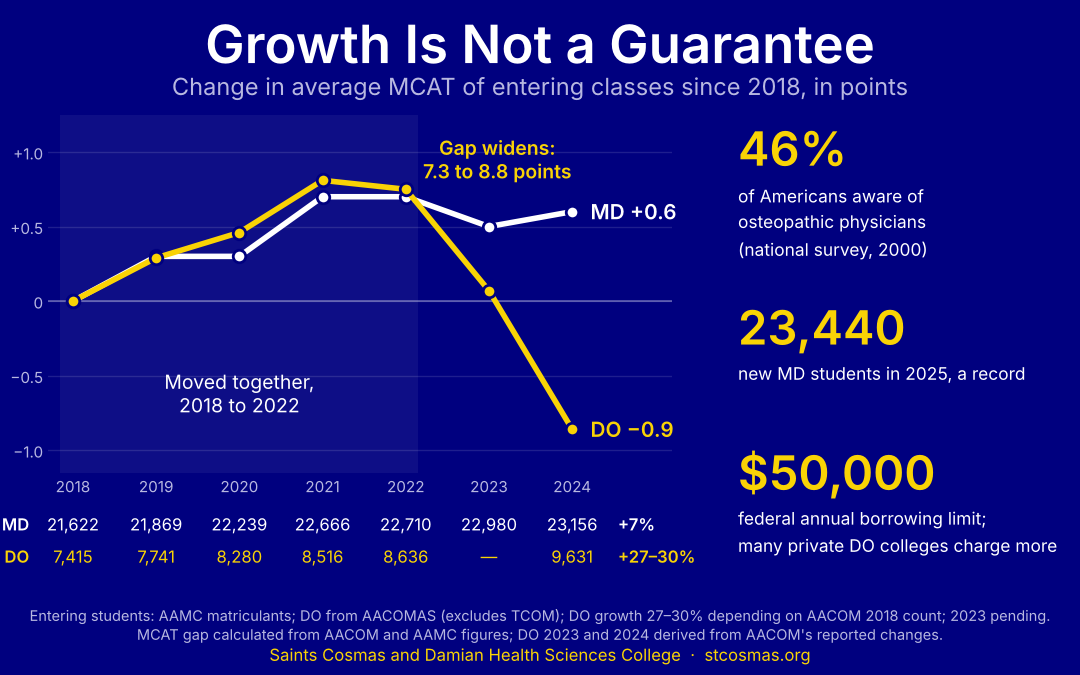
The growth has been real. The AOA counted more than 167,000 DOs in 2025 and reported that more than a quarter of the nation’s medical students attended osteopathic colleges. (6) Recognition remains an issue. In 2000, a national telephone survey found that 46 percent of Americans were aware of osteopathic physicians. (7) Consumer research the AOA commissioned before its national campaign found that nearly eight in ten insured patients had heard of DOs, (8) but the surveys measured different populations and cannot establish a comparable trend. Having heard of a profession is not the same as understanding it. A 2022 study of frequently asked Google questions about osteopathic medicine found that nearly half of the factual questions concerned what DOs are allowed to practice. (9) A recent review concluded that the degree remains under-recognized despite the profession’s growth. (10) The campaign itself generated more than 320 million impressions in a single year. (11) Impressions do not measure understanding; the campaign did not retire the question the Times asked.
One might reasonably ask why. The difficulty may be less clinical than lexical. Patients already understand “medical doctor.” Two unfamiliar letters—DO—ask them to learn a distinction that matters less in practice every year, now that graduates of both osteopathic and allopathic (Doctor of Medicine, MD) schools train side by side under a single residency accreditation system. (12) Familiarity by sheer numbers was always going to be a slow cure.
The deeper problem lies beneath the strategy: the assumption that the numbers will keep growing at their historic pace. From 2015–16 to 2025–26, first-year enrollment at colleges of osteopathic medicine rose about 60 percent, from 7,219 to more than 11,500, while the number of applicants rose about 11 percent, from 20,835 to 23,114. (13) These figures suggest that capacity expanded much faster than the applicant pool, although first-year enrollment and new matriculants are not necessarily identical measures. The number of applicants peaked at 27,277 in 2021 and fell for three years. (14) It rebounded in 2026 to 26,506, the highest level since 2021. (15) That rebound cuts against any simple forecast of declining demand and deserves to be stated plainly. Even if new enrollment stopped growing, the number of practicing DOs might continue to rise for years as new physicians entered practice and older cohorts retired.
However, admissions trends raise questions about how readily schools can continue expanding. From 2018 through 2022, the average MCAT scores of entering DO and MD classes rose together, with a gap of about 7.3 points. In 2023 and 2024, the MD average held while the DO average fell; by 2024 the gap had widened to about 8.8 points, calculated from the two associations’ figures. (16,17) Grade averages suggest a smaller divergence: the MD average continued rising while the DO average leveled off. (17,18) Over the same years, osteopathic colleges enlarged their entering classes by more than a quarter; MD schools, by about 7 percent. (14,17,19,20) The divergence is consistent with more osteopathic seats competing for an applicant pool that did not expand proportionately. It does not establish that expansion caused lower average scores, or that students with lower scores will become less capable physicians. New schools, differences in institutional missions, applicant preferences, and admissions priorities could also affect the averages. These aggregate measures warrant attention but do not by themselves establish that osteopathic enrollment will decline.
Meanwhile, schools granting the MD degree are adding seats of their own. They enrolled a record 23,440 new students in 2025, compared with 21,030 in 2016—an increase of about 11 percent. (21,22) As of October 2026, their accreditor listed eleven programs holding preliminary or provisional accreditation, first granted between 2020 and 2026, and five more applicants or candidates. (23) In Tennessee, East Tennessee State University’s Quillen College of Medicine raised its entering class from 78 to 100 in 2026, (24) and the University of Tennessee Health Science Center in Memphis enrolled 181 new students, its largest class to that point. (25) Published annual charges cited for Tennessee residents are $37,560 at the University of Tennessee and $38,900 at East Tennessee State, compared with $55,166 and $59,550 at the state’s two osteopathic colleges. (26–29) These figures are not necessarily like-for-like: some sources report tuition alone and others include mandatory fees, and actual costs depend on residency status and financial aid. Even so, the published figures illustrate the potential price advantage of state-supported MD programs. Each additional lower-cost MD seat may compete for an applicant who would otherwise consider a DO school; the available figures do not establish a one-for-one substitution.
Then there is the money. Federal law establishes new borrowing limits of $50,000 per year and $200,000 in aggregate for professional students, including medical students, and ends new Graduate PLUS borrowing, subject to statutory transition provisions for some continuing borrowers. (30) The new framework applies beginning July 1, 2026. (31) Tuition alone at many private osteopathic colleges exceeds the annual professional borrowing limit; some published charges exceed $85,000. (32) Tuition is only part of the cost of attendance, which also includes living expenses and other educational costs. Students facing a financing gap may need scholarships, grants, personal resources, or private loans, for which eligibility and terms depend on credit and other underwriting factors. Institutions with dental, veterinary, pharmacy, and physician assistant programs face related financing challenges, although the applicable federal limits differ by program classification. (31) It is too early to know how these changes will affect osteopathic applications, matriculation, or institutional finances.
None of this means the profession will shrink. First-year enrollment, the number of practicing physicians, and public recognition can move in different directions. It means only that continued rapid educational expansion cannot be assumed, and that a public-relations strategy relying on growth alone makes recognition depend on an uncertain outcome. More DOs do not necessarily produce better public understanding. If enrollment levels off, the question the Times asked may still be there. The students who borrowed to become DOs may carry both the debt and the explaining.
Perhaps the question was never how many DOs there must be before the public understands. It may be whether two letters can ever carry the meaning of two plain words, medical doctor.
Additional, information about how the numbers behind the chart were found and calculated is availalbe here.
References
1. Rosenbluth T. So your doctor is a D.O. Does that matter? New York Times. July 13, 2025.
2. The DO Staff. Osteopathic medicine highlighted in recent New York Times article. The DO. July 14, 2025. https://thedo.osteopathic.org/2025/07/osteopathic-medicine-highlighted-in-recent-new-york-times-article/ (Accessed October 15, 2026).
3. Gevitz N. The DOs: Osteopathic Medicine in America. 3rd ed. Johns Hopkins University Press; 2019.
4. Selby L. AOA CEO: “People are looking for DOs like never before.” The DO. July 23, 2016. https://thedo.osteopathic.org/2016/07/aoa-ceo-people-are-looking-for-dos-like-never-before (Accessed October 15, 2026).
5. Philadelphia College of Osteopathic Medicine. AOA president discusses DO profession growth. November 30, 2017. https://www.pcom.edu/campuses/georgia-campus/news-and-events/ga-pcom-news/aoa-president-discusses-growth.html (Accessed October 15, 2026).
6. The DO Staff. A story of growth. The DO. October 30, 2025. https://thedo.osteopathic.org/2025/10/number-of-dos-osteopathic-medical-students-surpasses-the-200k-mark/ (Accessed October 15, 2026).
7. Licciardone JC. Awareness and use of osteopathic physicians in the United States: results of the Second Osteopathic Survey of Health Care in America (OSTEOSURV-II). J Am Osteopath Assoc. 2003;103(6):281-289.
8. Selby L. Data-driven: how consumer research guided the national awareness campaign. The DO. January 22, 2016. https://thedo.osteopathic.org/2016/01/data-driven-how-consumer-research-guided-the-national-awareness-campaign/ (Accessed October 15, 2026).
9. Sajjadi NB, Ottwell R, Shepard S, et al. Assessing the United States’ most frequently asked questions about osteopathic medicine, osteopathic education, and osteopathic manipulative treatment. J Osteopath Med. 2022;122(5):219-227. doi:10.1515/jom-2021-0281.
10. Garcia R, English K. Doctor of osteopathic medicine degree still faces recognition challenges in the United States: suggested ways to improve awareness. World J Methodol. 2026;16(3):118145. doi:10.5662/wjm.118145.
11. Palikuca S. AOA’s brand campaign is thriving in its second year. The DO. July 25, 2017. https://thedo.osteopathic.org/2017/07/aoas-brand-campaign-is-thriving-in-its-second-year/ (Accessed October 15, 2026).
12. Buser BR, Swartwout J, Gross C, Biszewski M. The single GME accreditation system will change the future of the osteopathic medical profession. J Am Osteopath Assoc. 2015;115(4):251-255.
13. American Association of Colleges of Osteopathic Medicine. Quick facts: osteopathic medical school growth trends, 2015-16 to 2025-26. https://www.aacom.org/news-and-events/fast-facts (Accessed October 15, 2026). Note: Years are academic years; the 2025-26 class entered in the fall of 2025. First-year enrollment is reported by the colleges and counts every student in the first year, which can include students repeating it and students at the Texas College of Osteopathic Medicine, which does not use AACOM’s application service. Matriculants are new students admitted through that service. AACOM’s report Applicants, Matriculants, Enrollment and Graduates 1977-78 – 2025-26 (September 4, 2026; https://www.aacom.org/searches/reports/report/applicants-enrollment-and-graduates-1977-78—2023-24) gives 10,297 matriculants for 2025-26 and first-year enrollment of 11,538 in one statement and 11,590 in another; the Quick Facts page gives 11,687. No count for the class entering in the fall of 2026 had been published when this essay was written.
14. Guercio E. Applicants & matriculants 1977-2024. American Association of Colleges of Osteopathic Medicine. November 18, 2024. https://aacom.org/searches/reports/report/applicants—matriculants-2009-2024 (Accessed October 15, 2026).
15. American Association of Colleges of Osteopathic Medicine. Osteopathic medical school applications jump more than 12 percent. June 22, 2026. https://www.aacom.org/news-reports/news/2026/06/22/osteopathic-medical-school-applications-jump-more-than-12-percent (Accessed October 15, 2026).
16. Guercio E. Applicant & matriculant average MCAT 2016-2024. American Association of Colleges of Osteopathic Medicine. November 21, 2024. https://www.aacom.org/searches/reports/report/applicant-and-matriculant-average-mcat-2016-2023 (Accessed October 15, 2026).
17. Association of American Medical Colleges. Table A-16: MCAT scores and GPAs for applicants and matriculants to U.S. MD-granting medical schools, 2020-2021 through 2025-2026. https://www.aamc.org/media/86686/download (Accessed October 15, 2026).
18. Guercio E. Applicants & matriculants average GPA 2016-2024. American Association of Colleges of Osteopathic Medicine. November 21, 2024. https://aacom.org/searches/reports/report/aacomas-applicants-and-matriculants-average-gpa-2016-2023 (Accessed October 15, 2026).
19. American Association of Colleges of Osteopathic Medicine. 2018 AACOMAS applicant & matriculant profile summary report. January 15, 2019. https://www.aacom.org/docs/default-source/research-archives/applicant-matriculant-profile-summary-reports/2018-aacomas-applicant-matriculant-profile-summary-report9e16b92f-955b-4149-a42f-04310dd4379d.pdf (Accessed October 15, 2026).
20. Association of American Medical Colleges. Table A-16: MCAT scores and GPAs for applicants and matriculants to U.S. medical schools, 2017-2018 through 2018-2019. https://www.aamc.org/media/72916/download (Accessed October 15, 2026).
21. Association of American Medical Colleges. U.S. medical schools enroll record number of students in 2025. https://www.aamc.org/news/us-medical-schools-enroll-record-number-students-2025 (Accessed October 15, 2026).
22. Association of American Medical Colleges. Table A-16: MCAT scores and GPAs for applicants and matriculants to U.S. medical schools, 2016-2017. December 6, 2016. https://www.aamc.org/media/74456/download (Accessed October 15, 2026).
23. Liaison Committee on Medical Education. Accredited MD programs; applicant and candidate programs. Updated October 14, 2026. https://lcme.org/directory/accredited-programs/ and https://lcme.org/directory/applicant-and-candidate-programs/ (Accessed October 15, 2026).
24. Quillen College of Medicine welcomes largest entering class in school history. Elizabethton Star. August 3, 2026. https://elizabethton.com/2026/08/03/quillen-college-of-medicine-welcomes-largest-entering-class-in-school-history/ (Accessed October 15, 2026).
25. University of Tennessee Health Science Center. More than a white coat: College of Medicine welcomes largest class in history. August 2026. https://news.uthsc.edu/more-than-a-white-coat-college-of-medicine-welcomes-largest-class-in-history/ (Accessed October 15, 2026).
26. University of Tennessee Health Science Center. College of Medicine cost of attendance, 2026-2027. https://webprod8.uthsc.edu/financial-aid/cost-of-attendance/documents/coa-medicine-2026-2027.pdf (Accessed October 15, 2026).
27. East Tennessee State University Quillen College of Medicine. Annual student budget. https://oupub.etsu.edu/com/sa/comfinaid/links/studentbudget.php (Accessed October 15, 2026).
28. Baptist Health Sciences University College of Osteopathic Medicine. Tuition and fee schedule, 2026-2027. https://www.baptistu.edu/sites/default/files/2026-2027%20FINAL%20COM%20Tuition%20and%20Fee%20Schedule%20-%20ADA%20Compliant.pdf (Accessed October 15, 2026).
29. American Association of Colleges of Osteopathic Medicine. Lincoln Memorial University-DeBusk College of Osteopathic Medicine. https://www.aacom.org/detail-pages/com/lincoln-memorial-university-debusk-college-of-osteopathic-medicine (Accessed October 15, 2026).
30. Pub L No. 119-21, §81001, 139 Stat 334-337 (2025).
31. American Hospital Association. DOE issues final rule with updated definition of professional student. April 30, 2026. https://www.aha.org/news/headline/2026-04-30-doe-issues-final-rule-updated-definition-professional-student (Accessed October 15, 2026).
32. American Association of Colleges of Osteopathic Medicine. Choose DO Explorer. https://www.aacom.org/explore-med-schools/choose-do-explorer (Accessed October 15, 2026).