
Graduates holding the Doctor of Osteopathic Medicine (DO) degree who borrowed for medical school reported average educational debt of $286,812 in 2025. (1) Since July 1, 2026, new professional borrowers generally face a $50,000 annual federal loan limit and a $200,000 aggregate limit for graduate and professional study, with no Grad PLUS loans. Undergraduate borrowing is excluded from that aggregate but counts toward a separate $257,500 lifetime ceiling. Eligible continuing students have a limited transition exception. (2,3) These changes sharpen a question: how do colleges share the financial benefits of medical education with the students financing it? Here, “extra money” means reported revenue exceeding expenses, not proof of excessive tuition or improper profit.
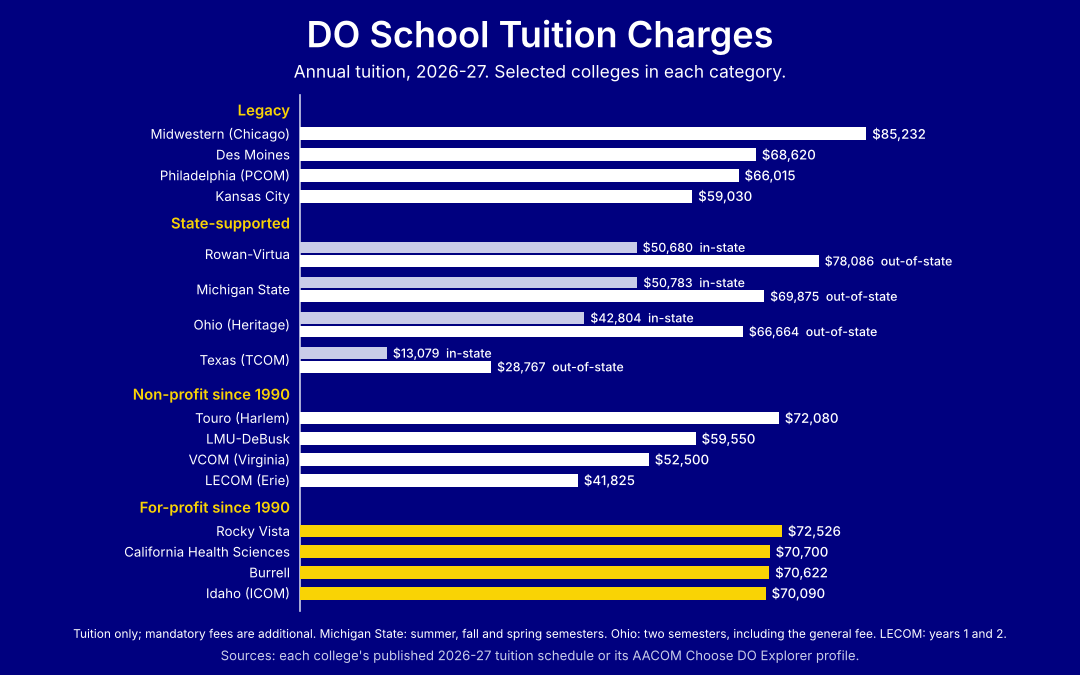
One should consider published 2026–27 tuition at selected colleges in four groups: older private colleges founded before 1960 (legacy colleges), state-supported colleges, newer private non-profits established since 1990, and newer for-profits. This illustrative comparison is not a representative sample or an enrollment ranking. Figures exclude mandatory fees and living costs; campus and class-year differences limit direct comparisons. (4-11)
The four for-profit colleges in the comparison charge $70,090 to $72,526 annually. Older private colleges range from $59,030 at Kansas City University to $85,232 at Midwestern University’s Chicago college. Among newer non-profits, the Lake Erie College of Osteopathic Medicine (LECOM) charges $41,825 at its Erie campus in each of the first two years, rising to $47,825 and $47,325 in the third and fourth; Touro’s Harlem campus charges $72,080. (4-9) Public colleges charge lower resident than non-resident tuition: the Texas College of Osteopathic Medicine lists $13,079 and $28,767, respectively; Rowan-Virtua lists $50,680 and $78,086. Texas adds about $6,800 in first-year fees. (10,11) These figures show a resident-price advantage, without isolating the effect of state subsidies. The American Association of Colleges of Osteopathic Medicine (AACOM) listed seven public colleges among 42 main campuses in its September 2024 inventory, apart from 25 additional locations. (12) Most osteopathic colleges are therefore private institutions without state sponsorship.
Debt also resists a simple ownership explanation. AACOM’s 2023–24 table reports average graduate debt of $223,972 to $290,423 at three reporting for-profits, compared with $229,774 to $330,000 at the four older private colleges. (13) In both comparisons the highest figure belongs to a non-profit: the highest reported debt in 2023–24 and the highest tuition in 2026–27. These are different measures and cohorts; neither establishes educational value.
Prices have been rising as well. Among eleven private colleges in this comparison with four classes enrolled in both periods, the sum of published tuition and fees across the four class years rose 6 to 12 percent between 2021–22 and 2023–24. (13,14) These cross-sectional totals are not the actual charges paid by a single graduating cohort.
Non-profit tax returns offer a partial answer about institutional finances. For the ten fiscal years ending June 2023, Midwestern reported approximately $4.47 billion in revenue and $3.34 billion in expenses: a cumulative excess of $1.13 billion, or about 25 percent of revenue. Roughly 95 percent was classified as program-service revenue, which need not consist solely of tuition. Reported net assets rose from $622 million to $1.66 billion. (15) Kansas City University reported a ten-year revenue–expense excess of $208 million on $863 million in revenue. (16)
Three distinctions matter. Revenue less expenses is an accounting result, not cash available for scholarships or other uses. Net assets represent institutional wealth, potentially including restricted funds, buildings, and investment changes. Educational expenditure is what the institution devotes to teaching, clinical training, and student support. These whole-university figures do not isolate DO programs or establish that tuition alone produced accumulated wealth. A college’s financial strength is not necessarily evidence of affordability for its students.
What follows is inference, not record. Beginning in 2006, eligible graduate and professional students could use Grad PLUS to finance the cost of attendance less other aid, subject to credit and other eligibility requirements. (17,18) That applied to pharmacy, dentistry, optometry, podiatry, and veterinary medicine as well as medicine. A board with accumulated reserves could reasonably treat a new professional program as an investment, since its students could borrow up to the cost of attendance from the federal government. Midwestern has added colleges in each of those fields and an Arizona campus; Kansas City University opened its Joplin medical campus in 2017, which it said would serve regional primary care and rural health needs, and committed $40 million toward a dental college announced in 2019. (19-21) Federal lending does not establish why either expanded. Workforce needs, student demand, and institutional mission offer other explanations. Growth may spread some fixed costs, while creating others. In a non-profit, financial gains remain within the institution rather than being distributed to owners.
Who shares in those gains? LECOM combines substantial DO enrollment with comparatively low private tuition, while Midwestern’s diversified institution charges considerably more. (6,22) Both are non-profits. Their prices establish a difference, not its explanation. Reserves and expansion can serve future students and communities, but current students may reasonably ask how those investments benefit them.
For privately held for-profit colleges, the public record is thinner. They generally do not file the publicly available Form 990 required of tax-exempt non-profits. Students can inspect Midwestern’s reported revenue, expenses and net assets; comparable information about a privately held competitor may be unavailable. Tuition is likely a principal source supporting educational operations and investor returns, although other revenue is possible. Idaho’s college identifies investment interests among its owners. (23) Ownership alone does not establish the size or form of any return.
A comparison with schools granting the Doctor of Medicine (MD) degree raises a related question about resources. Most MD schools are non-profit; documented for-profit examples are California Northstate University College of Medicine and Ponce Health Sciences University School of Medicine. (24,25) Many MD schools belong to research universities or academic medical centers. Liaison Committee on Medical Education (LCME) accreditation requires support for student research opportunities; Commission on Osteopathic College Accreditation (COCA) requires policies supporting student-led scholarship and participation in faculty research at all campuses. These are related obligations, not identical requirements. (26,27) Having both requirements on paper does not establish equivalent research access or clinical experience. Research and clinical revenues may support broader institutional missions and cannot simply be counted as money spent educating each student.
Price, institutional wealth, and educational value are distinct. Colleges should explain spending per student on instruction and clinical education, faculty and research access, rotation arrangements, scholarships, residency outcomes, and allocations to expansion. Comparable disclosures would help students judge what a higher price buys. Neither tuition nor ownership status alone can answer that question.
The new loan limits may force choices that broad federal financing allowed colleges to postpone. Students whose costs exceed available aid must find family resources, scholarships, or private credit. Institutions with substantial unrestricted resources can consider moderating tuition or expanding grants; others face tighter constraints. Reserves may be justified, and expansion may serve a public purpose. But students financing both deserve an answer: how much of what they pay supports their education, and how much supports the institution’s future? That accountability should apply to every college, whatever its ownership.
References
1. American Association of Colleges of Osteopathic Medicine. 2024-2025 Academic Year Graduating Seniors Survey Summary Report. AACOM; 2026. https://www.aacom.org/searches/reports/report/2024-2025-academic-year-graduating-seniors-survey-summary-report (Accessed October 11, 2026).
2. Pub L No. 119-21, §81001, 139 Stat 334-337 (2025).
3. Federal Student Aid. Updates to federal student aid. US Department of Education. https://studentaid.gov/announcements-events/big-updates (Accessed October 11, 2026).
4. American Association of Colleges of Osteopathic Medicine. Choose DO Explorer: college profiles. https://www.aacom.org/explore-med-schools/choose-do-explorer (Accessed October 11, 2026).
5. Kansas City University. College of Osteopathic Medicine tuition, academic year 2026-2027. https://kansascity.edu/admissions/financial-aid/tuition/com (Accessed October 11, 2026).
6. Lake Erie College of Osteopathic Medicine. LECOM Erie tuition and fees, 2026-2027. https://lecom.edu/?p=401 (Accessed October 11, 2026).
7. Edward Via College of Osteopathic Medicine. 2026-27 cost of attendance, OMS 1, class of 2030. https://www.vcom.edu/sites/default/files/inline-files/2026-27%20COA%20-%20OMS1%20-%20Class%20of%202030.pdf (Accessed October 11, 2026).
8. Rocky Vista University. Tuition and fees, 2026-2027. https://www.rvu.edu/admissions/financial-aid/tuition-and-fees/ (Accessed October 11, 2026).
9. Idaho College of Osteopathic Medicine. Student accounts: 2026-2027 annual tuition and fees. https://www.icom.edu/students/student-accounts/ (Accessed October 11, 2026).
10. University of North Texas Health Science Center at Fort Worth. TCOM tuition and fees: D.O. year 1, 2026-2027. https://www.unthealth.edu/tuition-and-fees/tcom-tuition-and-fees/d-o-year-1.html (Accessed October 11, 2026).
11. Rowan-Virtua School of Osteopathic Medicine. DO program cost of attendance, 2026-2027. https://som.rowan.edu/education/financialaid/do-program/ (Accessed October 11, 2026).
12. Guercio E. Osteopathic Medical Colleges by Type, Investor Owned Status, City, State and Inaugural Class. American Association of Colleges of Osteopathic Medicine; September 20, 2024. https://aacom.org/searches/reports/report/osteopathic-medical-colleges-by-type-profit-status-city-state-and-inaugural-class (Accessed October 11, 2026).
13. American Association of Colleges of Osteopathic Medicine. 2023-24 Osteopathic Medical College Cost of Attendance. AACOM; 2024. https://www.aacom.org/docs/default-source/research-reports/2023-24-coa_pdf.pdf?sfvrsn=a6e7e781_7 (Accessed October 11, 2026).
14. American Association of Colleges of Osteopathic Medicine. 2021-22 Osteopathic Medical College Cost of Attendance. AACOM; 2022. https://www.aacom.org/docs/default-source/research-reports/2021-22-coa_pdf.pdf?sfvrsn=57c8f950_12 (Accessed October 11, 2026).
15. ProPublica. Nonprofit Explorer: Midwestern University. Internal Revenue Service Form 990 data, fiscal years ended June 30, 2014, through June 30, 2023. https://projects.propublica.org/nonprofits/organizations/363377698 (Accessed October 11, 2026).
16. ProPublica. Nonprofit Explorer: Kansas City University. Internal Revenue Service Form 990 data, fiscal years ended June 30, 2014, through June 30, 2023. https://projects.propublica.org/nonprofits/organizations/440545280 (Accessed October 11, 2026).
17. Black SE, Turner LJ, Denning JT. PLUS or Minus? The Effect of Graduate School Loans on Access, Attainment, and Prices. National Bureau of Economic Research; 2023. NBER Working Paper 31291. https://www.nber.org/papers/w31291 (Accessed October 11, 2026).
18. Federal Student Aid. Direct PLUS loans for graduate or professional students. US Department of Education. https://studentaid.gov/understand-aid/types/loans/plus/grad (Accessed October 11, 2026).
19. Midwestern University. Our history. https://www.midwestern.edu/about/mission-vision/our-history (Accessed October 11, 2026).
20. KC University of Medicine & Biosciences. KCU opens first new medical school in Missouri in 46 years to serve as model for nation. PRWeb. June 8, 2017. https://www.prweb.com/releases/kcu_opens_first_new_medical_school_in_missouri_in_46_years_to_serve_as_model_for_nation/prweb14407941.htm (Accessed October 11, 2026).
21. Kansas City University. KCU announces plans for a College of Dental Medicine in Joplin, MO. June 4, 2019. https://kansascity.edu/blog/post/kcu-announces-plans-for-a-college-of-dental-medicine-in-joplin-mo (Accessed October 11, 2026).
22. American Association of Colleges of Osteopathic Medicine. Choose DO Explorer: Lake Erie College of Osteopathic Medicine. https://www.aacom.org/detail-pages/com/lake-erie-college-of-osteopathic-medicine (Accessed October 11, 2026).
23. Idaho College of Osteopathic Medicine. ICOM AI information. https://www.icom.edu/ai-information/ (Accessed October 11, 2026).
24. American Medical Association Council on Medical Education. For-Profit Medical Schools or Colleges. CME Report 1-I-19. American Medical Association; 2019. https://www.ama-assn.org/system/files/2019-10/i19-cme01.pdf (Accessed October 11, 2026).
25. Ponce Health Sciences University. School of Medicine, PR & US. https://phsu.edu/academics/schools/schools_of_medicine/school-of-medicine-pr-us.php (Accessed October 11, 2026).
26. Liaison Committee on Medical Education. Functions and Structure of a Medical School: Standards for Accreditation of Medical Education Programs Leading to the MD Degree. Academic year 2026-27. Elements 3.2 and 5.5. https://lcme.org/publications/standards/ (Accessed October 11, 2026).
27. Commission on Osteopathic College Accreditation. Accreditation of Colleges of Osteopathic Medicine: COM Continuing Accreditation Standards. Standard 8, especially Element 8.4, and Elements 6.9 and 6.10. Effective July 1, 2026. https://osteopathic.org/wp-content/uploads/COCA-2026-COM-Continuing-Accreditation-Standards.pdf (Accessed October 11, 2026).