
For most of the last century, physicians holding the Doctor of Osteopathic Medicine (DO) degree and those holding the Doctor of Medicine (MD) degree trained in separate residency systems. That separation ended on June 30, 2020, when a five-year transition made the Accreditation Council for Graduate Medical Education (ACGME) the sole accreditor of residencies and fellowships for both. (1)
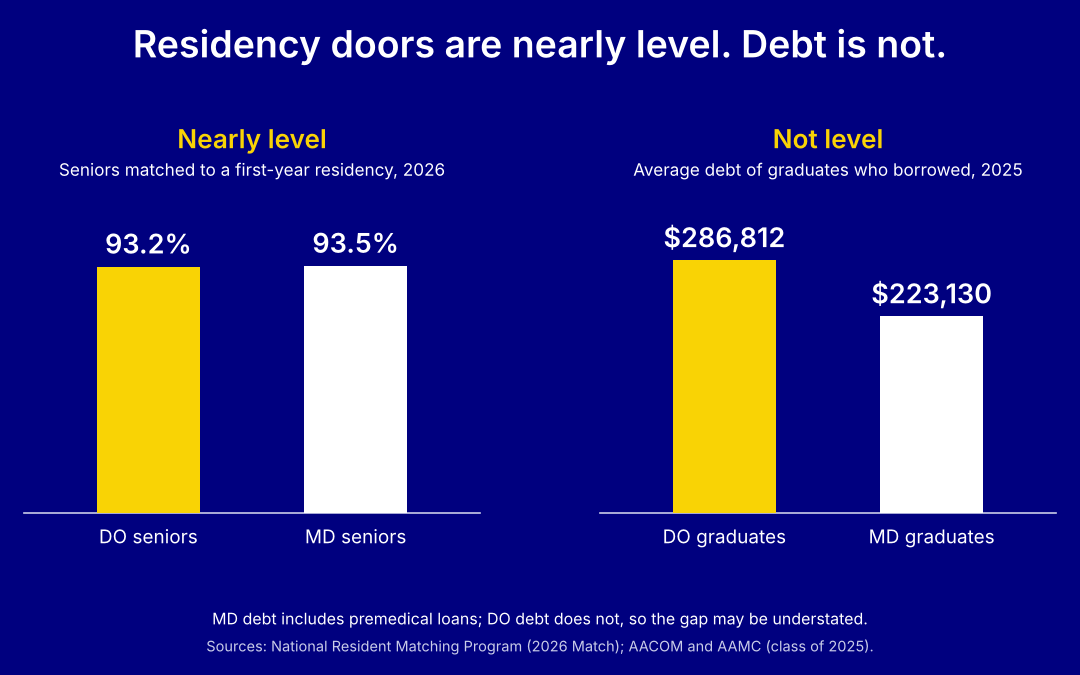
Six years on, the results are in. In the 2026 Main Residency Match, 93.2 percent of DO seniors matched to a first-year position, the highest rate on record. The rate for MD seniors was 93.5 percent. (2) When positions filled after the Match are counted, DO seniors placed at 98.5 percent and MD seniors at 97.8 percent. (3) On the basic question of whether graduates enter residency training, the two degrees now stand nearly even.
Where graduates train is another matter. DO seniors were about 29 percent of United States seniors in the 2026 Match. They filled nearly half of the family medicine positions taken by United States seniors and 44 percent of those in emergency medicine, but 14 percent in orthopaedic surgery, 6 percent in otolaryngology and 2 percent in integrated plastic surgery. (4) Those figures count who filled positions. They do not show who applied and was turned away, and many DO graduates choose primary care on purpose. Still, the pattern raises a question that accreditation cannot answer: what else shapes these choices?
One answer may be money. DO graduates of 2025 who borrowed owed an average of $286,812 for medical school, and 88 percent of the class borrowed. (5) MD graduates with debt owed an average of $223,130, and 70 percent had debt. (6) These are not identical measures: the MD figure includes premedical educational debt, while the DO figure reports medical-school debt. The comparison may therefore understate the difference in medical-school borrowing. DO seniors reported that loans paid for 73 percent of their medical education. (5)
In years past, eligible students could generally finance the full certified cost of attendance through federal loans. That changed for new borrowers on July 1, 2026. Under the 2025 budget law, federal loans for professional students are limited to $50,000 a year and $200,000 in total, and the Graduate PLUS program makes no new loans to them. (7,8) Transitional provisions preserve prior borrowing rules for certain already-enrolled borrowers, subject to eligibility requirements and time limits. (8,9)
The new limit sits well below the price of a degree. The average four-year cost of attendance at a private osteopathic college was $380,501 in 2024-25, and $319,498 at a public one. (10) At those prices, a student entering a private college and able to borrow the full $200,000 federal professional-loan amount would still face an illustrative shortfall of about $180,000.
The limit applies to MD students too, and private MD schools cost about as much. The median four-year cost for the MD class of 2025 was $390,848 at private schools. (11) These figures use different measures—an average for DO schools and a median for MD schools—but demonstrate that high costs are not confined to one degree. The rule is the same for both. Its potential weight differs because more DO students borrow, and borrowers report higher debt.
Students may turn to family resources or private loans to cover the gap. Private loans differ from federal loans in a way that matters to physicians. Public Service Loan Forgiveness requires 120 qualifying payments on eligible federal Direct Loans. (12) Private loans do not qualify. As private borrowing replaces federal borrowing, a smaller share of a physician’s debt may be eligible for federal repayment protections and forgiveness.
That distinction may matter for specialty choice. A study of survey data from 2007 to 2016 found that high-debt DO graduates who used forgiveness or repayment programs were more likely to enter primary care, while high-debt graduates who did not were more likely to enter other specialties. (13) The authors cautioned that their study could not establish cause. A systematic review found that most, though not all, of the studies it examined associated higher debt with the pursuit of higher-paying specialties. (14) These studies do not establish what graduates will do under the new lending rules.
Put the pieces together. DO borrowers already report substantial educational debt, and future students may finance a growing share of their education through private lenders. The consequences for specialty choice remain uncertain, but the financial incentives are changing. For a graduate weighing family medicine in a rural county against a better-paid specialty, debt that forgiveness cannot reach may weigh more heavily. The first effect, however, comes earlier: students without family resources may find it harder to finance medical school at all.
Under the single accreditation system, DO and MD graduates now enter residency training at nearly the same rate. It did not address the difference in what they borrow to get there. That raises another question: where does the money go?
References
1. Accreditation Council for Graduate Medical Education. ACGME, AOA, and AACOM usher in new era of single accreditation for graduate medical education. News release. July 1, 2020. https://www.acgme.org/newsroom/2020/7/acgme-aoa-and-aacom-usher-in-new-era-of-single-accreditation-for-graduate-medical-education/ (Accessed October 11, 2026)
2. National Resident Matching Program. NRMP releases results of the 2026 Main Residency Match for more than 38,000 future residents. News release. March 20, 2026. https://www.nrmp.org/about/news/2026/03/nrmp-releases-results-of-the-2026-main-residency-match-for-more-than-38000-future-residents/ (Accessed October 11, 2026)
3. National Resident Matching Program. New reports: 2026 Main Residency Match outcome and demographic reports. May 26, 2026. https://www.nrmp.org/about/news/2026/05/new-reports-2026-main-residency-match-outcome-and-demographic-reports/ (Accessed October 11, 2026)
4. National Resident Matching Program. Advance Data Tables: 2026 Main Residency Match. NRMP; March 2026. Table 2. https://www.nrmp.org/wp-content/uploads/2026/03/Advance-Data-Tables-2026_Public.pdf (Accessed October 11, 2026)
5. American Association of Colleges of Osteopathic Medicine. 2024-2025 Academic Year Graduating Seniors Survey Summary Report. AACOM; 2026. https://www.aacom.org/searches/reports/report/2024-2025-academic-year-graduating-seniors-survey-summary-report (Accessed October 11, 2026)
6. Association of American Medical Colleges. Medical Student Education: Debt, Costs, and Loan Repayment Fact Card for the Class of 2025. AAMC; 2025. https://store.aamc.org/medical-student-education-debt-costs-and-loan-repayment-fact-card-for-the-class-of-2025.html (Accessed October 11, 2026)
7. Pub L No. 119-21, §81001, 139 Stat 334-337 (2025).
8. US Department of Education. Fact sheet: Trump administration implements student loan provisions of the Working Families Tax Cuts Act. April 30, 2026. https://www.ed.gov/media/document/rise-final-rule-fact-sheet-113947.pdf (Accessed October 11, 2026)
9. Congressional Research Service. Student Loan Types and Limits in the FY2025 Budget Reconciliation Act. CRS Insight IN12585. July 10, 2025. https://www.everycrsreport.com/files/2025-07-10_IN12585_83f5a79a172705231b75d890153b8a2566f1a59b.html (Accessed October 11, 2026)
10. Ali A. 2024-25 Osteopathic Medical College Cost of Attendance. American Association of Colleges of Osteopathic Medicine; November 22, 2025. https://www.aacom.org/searches/reports/report/2024-25-osteopathic-medical-college-cost-of-attendance (Accessed October 11, 2026)
11. Balch B. Proposed changes to federal student loans could worsen the doctor shortage. AAMCNews. June 25, 2025. https://www.aamc.org/news/proposed-changes-federal-student-loans-could-worsen-doctor-shortage (Accessed October 11, 2026)
12. Public Service Loan Forgiveness Program, 34 CFR §685.219. https://www.ecfr.gov/current/title-34/subtitle-B/chapter-VI/part-685/subpart-B/section-685.219 (Accessed October 11, 2026)
13. Scheckel CJ, Richards J, Newman JR, et al. Role of debt and loan forgiveness/repayment programs in osteopathic medical graduates’ plans to enter primary care. J Am Osteopath Assoc. 2019;119(4):227-235. doi:10.7556/jaoa.2019.038
14. Pisaniello MS, Asahina AT, Bacchi S, et al. Effect of medical student debt on mental health, academic performance and specialty choice: a systematic review. BMJ Open. 2019;9(7):e029980. doi:10.1136/bmjopen-2019-029980